
You’re three weeks past the breakup and still crying in your car between meetings. Your friend got over her ex in two months flat. Your coworker took a year. And you’re left wondering if you’re broken, too slow, or doing something terribly wrong.
Here’s the truth nobody wants to hear: there’s no universal timer on heartbreak. But there are patterns, research-backed timelines, and signs that can help you understand where you are in the process and what’s actually normal.
Research suggests most people take three to six months to recover from a breakup, but relationship length, [attachment style](https://en.wikipedia.org/wiki/Attachment_theory), and who initiated the split significantly impact healing time. The real question isn’t how fast you heal, but whether you’re moving forward. Expect waves of progress, not linear improvement, and focus on building a life you love rather than hitting an arbitrary timeline.
What the research actually says about breakup recovery time
Scientists have tried to pin down healing timelines, and the results are messier than you’d hope.
A 2015 study published in The Journal of Positive Psychology found that most people showed significant emotional improvement around 11 weeks after a breakup. But “significant improvement” doesn’t mean fully healed. It means functional.
Another study from 2007 tracked college students post-breakup and found that the average person felt “recovered” after about three months. The catch? That timeline doubled for relationships lasting over a year.
Here’s where it gets interesting. The same research showed that people who initiated the breakup recovered 30% faster than those who were dumped. Not surprising, but worth noting if you’re comparing your timeline to your ex’s suspiciously cheerful Instagram posts.
The commonly cited “half the length of the relationship” rule has no scientific backing. It’s a myth that sounds tidy but ignores how relationships actually work. A toxic six-month relationship might haunt you longer than a healthy two-year partnership that ran its course.
Factors that speed up or slow down your healing
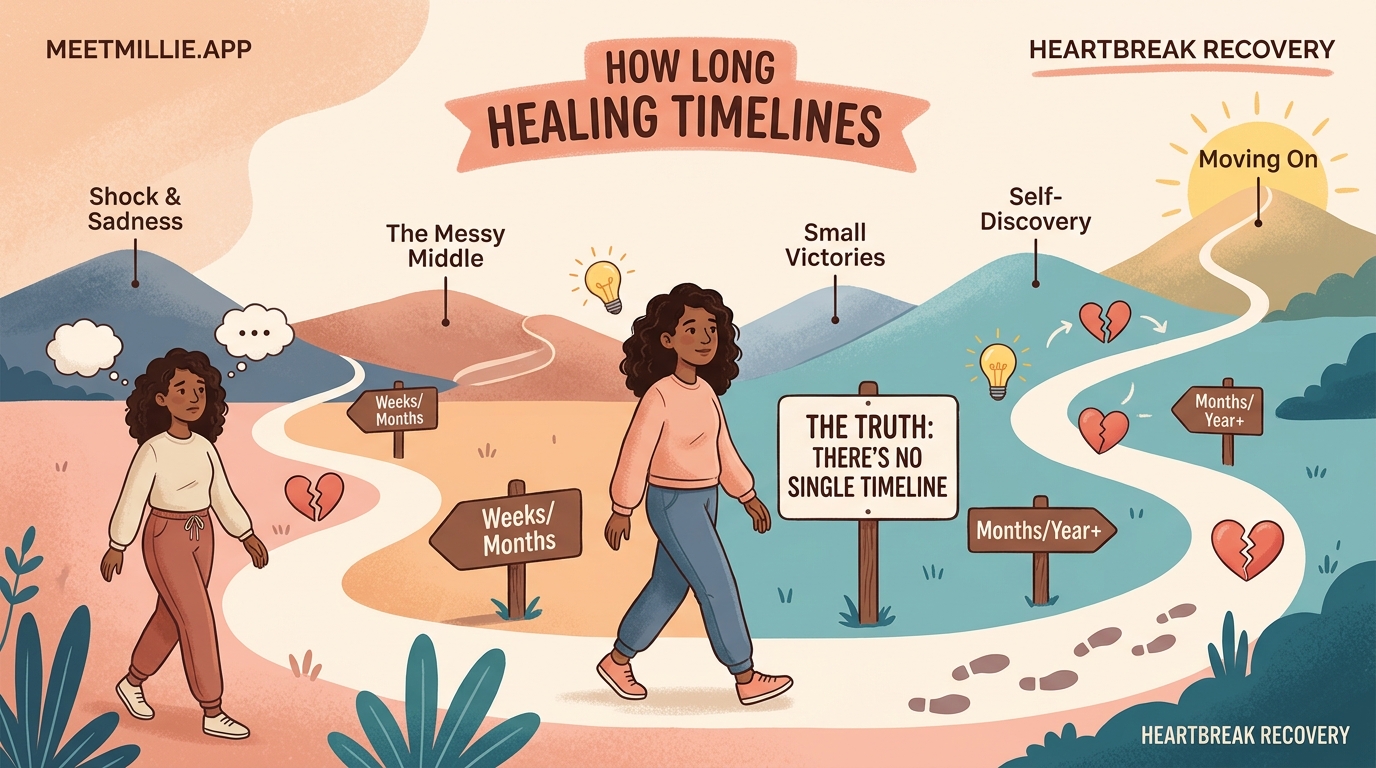
Not all breakups are created equal, and your recovery time depends on variables you might not have considered.
Relationship length matters, but not how you think. A three-year relationship where you saw each other twice a week might hurt less than a six-month relationship where you lived together. Entanglement beats duration.
Who ended it changes everything. Getting dumped activates rejection wounds that take longer to heal. You’re processing both the loss and the blow to your self-worth. If you ended things, you likely started grieving before the official breakup.
Your attachment style plays a huge role. Anxiously attached people typically struggle longer because they’re fighting both the breakup and their fear of being unlovable. Avoidantly attached people might seem fine for months, then crash later when the numbness wears off.
Shared social circles extend the pain. Running into your ex at mutual friends’ parties keeps reopening the wound. Every encounter resets part of your progress.
How the relationship ended matters. Being blindsided by infidelity or a sudden departure takes longer to process than a mutual, discussed decision. You need time to make sense of what happened before you can move forward.
The stages of breakup recovery (and why they don’t happen in order)
Forget the neat five-stage model. Real healing looks more like a drunk stumble than a straight line.
-
Shock and denial (Days 1-14, but sometimes longer). Your brain literally can’t process that it’s over. You reread old texts. You check their location. You convince yourself they’ll change their mind. This is normal. Your nervous system needs time to catch up to reality.
-
Grief and pain (Weeks 2-8, with random returns). This is when it hits. The crying jags, the inability to focus, the physical ache in your chest. You’re not being dramatic. Brain scans show that emotional pain activates the same regions as physical pain.
-
Anger and bargaining (Weeks 4-12, often overlapping with grief). You’re furious at them, yourself, the situation. You fantasize about what you could have done differently. You might even reach out trying to “fix” things. This stage is your brain’s attempt to regain control.
-
Depression and reflection (Months 2-4). Not clinical depression (though watch for that), but a heavy sadness as you accept it’s really over. You stop fighting reality and start sitting with the loss. This stage feels terrible but it’s where real healing begins.
-
Acceptance and rebuilding (Months 3-6 and beyond). You start having good days. You think about them less. You can imagine a future without them in it. This doesn’t mean you’re “over it” completely, but you’re building a life that doesn’t revolve around the loss.
These stages loop, overlap, and revisit you at random. You might feel fine for two weeks, then sob in the cereal aisle because they loved that brand of granola.
Signs you’re healing (even when it doesn’t feel like it)
Progress isn’t always obvious, especially when you’re in the middle of it. Watch for these markers:
- You can go a full day without thinking about them
- Their name doesn’t make your stomach drop anymore
- You stop checking their social media (or at least cut back)
- You’re genuinely interested in meeting new people
- You can talk about the relationship without crying or raging
- You’re making plans more than two weeks out
- Your sleep and appetite return to normal
- You’re rediscovering hobbies you abandoned during the relationship
One of the biggest signs? You stop asking yourself when you’ll be over it. The question itself becomes less urgent.
Common mistakes that extend your suffering
Some coping strategies feel helpful but actually keep you stuck.
Staying friends too soon. You need zero contact to reset your nervous system. Trying to be friends while you’re still in love is like trying to quit caffeine while working at Starbucks.
Dating immediately to prove you’re fine. Rebound relationships can be fun, but when you’re ready to date again after a breakup matters more than how fast you get back out there. Using new people to avoid your feelings just delays the inevitable crash.
Obsessively analyzing what went wrong. Some reflection is healthy. Spending six hours a day replaying conversations and reading relationship articles is avoidance disguised as self-improvement.
Comparing your timeline to others. Your friend who bounced back in three weeks might be suppressing everything. Or she might have been emotionally done long before the official breakup. Your pace is your pace.
Rushing to “closure.” That final conversation where everything makes sense rarely happens. Most closure comes from within, not from your ex finally explaining themselves in a way that satisfies you.
| Helpful Healing Behavior | Unhelpful Healing Behavior |
|---|---|
| Limiting social media checks to once a week | Obsessively monitoring their every post and story |
| Feeling your feelings as they come | Numbing out with substances or constant distraction |
| Talking to friends when you need support | Rehashing every detail of the breakup daily for months |
| Going no contact for at least 30 days | Texting them whenever you feel lonely or drunk |
| Trying new activities and meeting new people | Isolating completely and refusing all social invitations |
| Journaling about your experience | Sending long emails they’ll never read |
When to worry about your timeline
Sometimes grief becomes something more serious. Watch for these red flags:
- You can’t function at work or school after three months
- You’re having intrusive thoughts about self-harm
- You’ve completely isolated from friends and family
- You’re using alcohol or drugs to cope
- You can’t sleep more than a few hours a night for weeks
- You’ve lost significant weight or stopped basic self-care
- You’re experiencing panic attacks or severe anxiety
These symptoms might indicate depression or complicated grief that needs professional support. There’s no shame in getting help. Therapy can cut your healing time significantly and give you tools you’ll use forever.
“The people who heal fastest aren’t the ones who pretend it doesn’t hurt. They’re the ones who feel everything, process it, and actively build a new life rather than waiting to stop hurting before they start living again.” – Dr. Jennifer Rhodes, relationship psychologist
How to actually speed up your recovery (without bypassing the pain)
You can’t skip stages, but you can create conditions that support faster healing.
Establish a hard no-contact rule. Block, unfollow, delete the thread. Every interaction resets your progress. Your brain needs to detox from them like any other addiction.
Move your body daily. Exercise regulates cortisol and boosts endorphins. You don’t need to run marathons. A 20-minute walk works. The goal is to get out of your head and into your body.
Rebuild your identity outside the relationship. Who were you before them? What did you love that you stopped doing? Start there. Take that pottery class. Call that friend you neglected. Rediscover yourself piece by piece.
Set a “wallowing window.” Give yourself 30 minutes a day to feel everything. Cry, rage, journal, listen to sad music. Then close the window and do something else. This prevents both suppression and endless rumination.
Change your environment. Rearrange your room. Find a new coffee shop. Take a different route to work. Your brain associates places with memories. New spaces help create new neural pathways.
Talk to someone who gets it. Not the friend who says “just get over it.” Someone who understands that healing isn’t linear and won’t judge you for having a bad day three months in.
The difference between healing and being “over it”
Here’s something nobody tells you: you might never be completely “over” a significant relationship. And that’s okay.
Being healed doesn’t mean you never think about them. It means thinking about them doesn’t derail your day.
It doesn’t mean you have zero feelings. It means those feelings don’t control your choices.
It doesn’t mean you’ve erased them from your history. It means you’ve integrated the experience into your story without letting it define your future.
Some relationships leave marks. A five-year partnership that shaped your twenties doesn’t just evaporate. The goal isn’t to pretend it never happened. The goal is to carry the lessons without carrying the pain.
You’ll know you’re truly healed when you can wish them well and mean it. Not because you want them back, but because they’re no longer taking up rent-free space in your head.
What happens after you’ve healed
The other side of heartbreak looks different than you imagine when you’re in the thick of it.
You’ll meet someone new and realize you couldn’t have appreciated them if you were still with your ex. You’ll feel grateful for the timing, even if it hurt like hell at the time.
You’ll look back at the relationship with clear eyes and see both the good parts and the red flags you ignored. You’ll understand why it ended and feel relieved it did.
You’ll recognize your own patterns and make different choices. Maybe you’ll set boundaries earlier. Maybe you’ll spot red flags before you’re in too deep. Maybe you’ll choose yourself faster next time.
Most importantly, you’ll trust yourself again. You’ll know that you survived something that felt unsurvivable. You’ll carry that strength into everything else.
Your timeline is yours alone
Stop Googling “how long does it take to get over a breakup” at 2am hoping for a magic number that will make you feel normal.
Three months, six months, a year – these are averages, not assignments. Your relationship was unique. Your attachment was unique. Your healing will be unique.
The only timeline that matters is whether you’re moving forward, even in tiny increments. Did you cry for 20 minutes today instead of two hours? Progress. Did you make plans with friends instead of canceling? Progress. Did you go one evening without checking their Instagram? Progress.
Healing isn’t about hitting some finish line where you suddenly feel nothing. It’s about building a life so full and rich that your ex becomes a smaller and smaller part of the landscape.
Some days will feel like starting over. That’s normal. Grief isn’t linear. Healing isn’t either.
Be patient with yourself. Feel everything. And keep building your new life, one small choice at a time. You’re not broken. You’re not too slow. You’re exactly where you need to be.