
You’ve had a long day. You’re exhausted, overwhelmed, and all you want is for your partner to notice and do something helpful without you having to ask. But they’re scrolling through their phone, completely oblivious to your silent suffering. Sound familiar?
Here’s the uncomfortable truth: your partner can’t read your mind, and expecting them to is setting both of you up for resentment and disappointment.
Mind reading expectations damage relationships because they create unspoken needs and unmet expectations. Clear, direct communication using [“I” statements](https://en.wikipedia.org/wiki/I-message) and specific requests transforms frustration into connection. Your partner isn’t ignoring you; they simply don’t have access to your internal experience. Learning to express needs explicitly rather than hoping someone will guess them builds trust, reduces conflict, and creates genuine intimacy in your relationship.
Why We Expect Our Partners to Just Know
The fantasy of being understood without words runs deep. Movies and romance novels have sold us the idea that true love means someone who anticipates our every need.
But that’s fiction, not reality.
Research shows that even people who’ve been together for decades regularly misinterpret each other’s needs and emotions. A study from the University of Chicago found that people consistently overestimate how well they understand their partners and how well their partners understand them.
We fall into this trap for several reasons:
- We assume our needs are obvious because they’re so clear to us
- We fear being vulnerable or “needy” if we ask directly
- We test our partner’s love by seeing if they’ll figure it out
- We learned indirect communication patterns from our families growing up
- We worry that having to ask somehow makes the gesture less meaningful
None of these reasons make the expectation any more realistic or helpful.
The Real Cost of Silent Expectations

Expecting your partner to read your mind creates a lose-lose situation for everyone involved.
You end up feeling unseen, unheard, and uncared for. Your partner ends up feeling confused, criticized, and like they’re constantly failing at something they didn’t even know was a test.
This pattern breeds resentment faster than almost anything else in relationships. You’re upset they didn’t do the thing you never asked them to do. They’re frustrated by your disappointment over something they had no way of knowing about.
The distance grows. The frustration builds. Both people start walking on eggshells, which is exactly the opposite of the closeness you were hoping for.
“The expectation that a partner should know what you need without being told is one of the most damaging myths in modern relationships. It creates an impossible standard that leaves both people feeling inadequate.” – Dr. John Gottman, relationship researcher
What Your Partner Actually Needs to Hear
Instead of hoping your partner will magically intuit your needs, try these specific communication strategies.
Use “I” Statements with Specific Requests
Replace vague hints with clear, direct language that explains both your feeling and your need.
Instead of: Sighing loudly and saying “I’m fine” when you’re clearly not
Try: “I’m feeling overwhelmed right now. Could you handle dinner tonight so I can take a bath?”
Instead of: “You never help around the house”
Try: “I feel stressed when the kitchen is messy. Would you be willing to load the dishwasher after meals?”
Instead of: Dropping hints about wanting more quality time
Try: “I miss spending time with just you. Can we plan a date night this weekend?”
The formula is simple: feeling + need + specific request.
Name the Pattern You Want to Change
Sometimes the issue isn’t a single moment but an ongoing dynamic. Address it directly.
“I’ve noticed I’ve been expecting you to guess what I need instead of just telling you. I want to work on being more direct because I know that’s not fair to either of us.”
This approach acknowledges your role in the pattern and invites collaboration rather than blame.
Ask for What You Need in the Moment
Timing matters. Don’t wait until you’re at a breaking point to finally speak up.
Practice asking for small things regularly so it becomes natural:
- “I need a hug right now”
- “Can you listen while I vent for five minutes?”
- “I need some alone time to recharge”
- “Would you mind running that errand so I can finish this project?”
The more you practice direct requests in low-stakes situations, the easier it becomes when the stakes are higher.
The Communication Formula That Actually Works
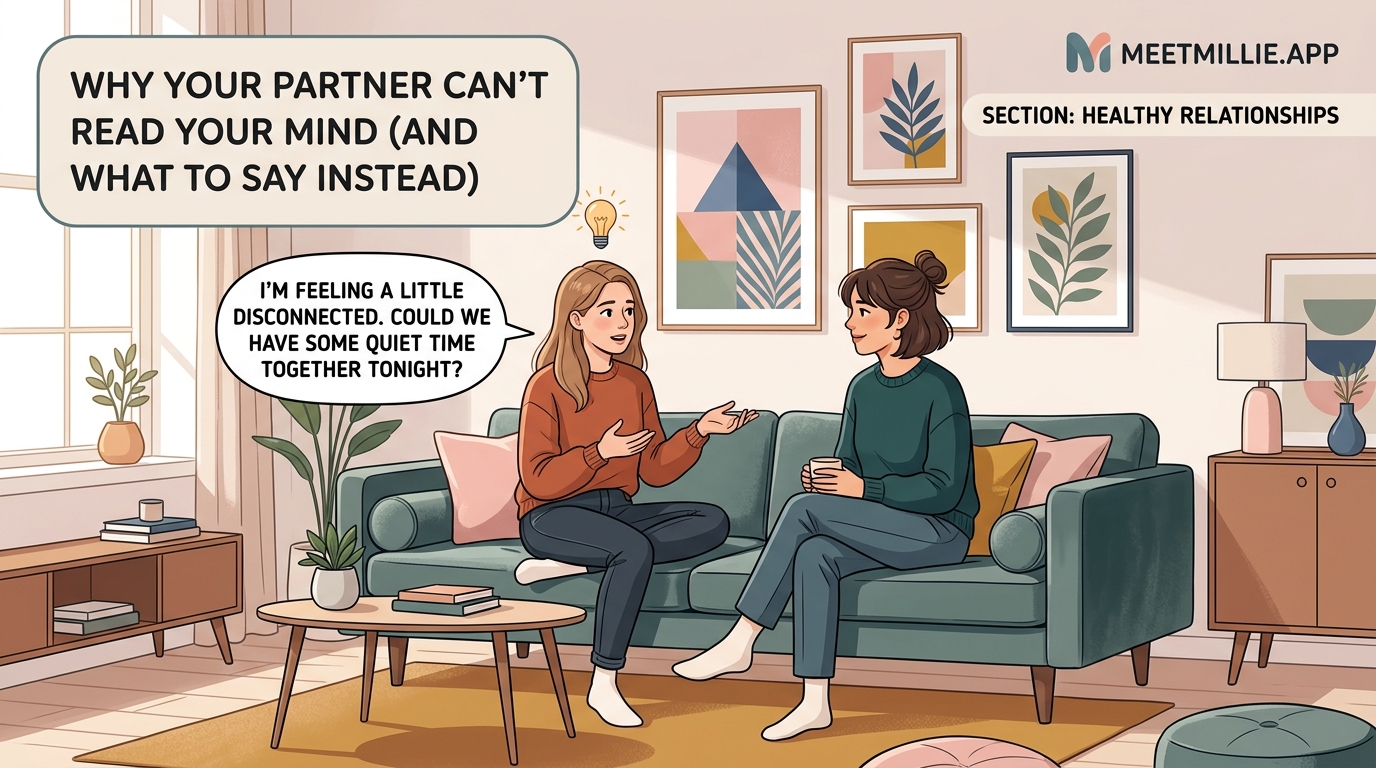
Here’s a step-by-step process for expressing needs instead of expecting mind reading.
-
Notice your expectation before it becomes resentment. Catch yourself thinking “they should know” and pause. That’s your cue to speak up.
-
Get clear on what you actually need. Sometimes we’re upset but haven’t identified the specific thing that would help. Take a moment to figure out the concrete request.
-
Choose a calm moment to communicate. Don’t try to have this conversation when you’re already angry or when your partner is distracted or stressed.
-
State your observation, feeling, and request. “I noticed [specific situation]. I feel [emotion]. I need [specific action]. Would you be willing to [request]?”
-
Listen to their response without defensiveness. They might have questions, concerns, or their own needs to express. This is a conversation, not a demand.
-
Appreciate the effort, not just the outcome. When your partner responds to a direct request, acknowledge it. This reinforces the new communication pattern.
Common Mind Reading Traps and What to Say Instead
Let’s look at specific scenarios where mind reading expectations show up and how to handle them differently.
| Situation | Mind Reading Trap | What to Say Instead |
|---|---|---|
| You’re upset about something at work | Expecting them to notice your mood and ask about it | “I had a rough day and need to talk it through. Do you have 20 minutes?” |
| You want affection or intimacy | Waiting for them to initiate and feeling rejected when they don’t | “I’m feeling disconnected from you lately. Can we spend some time being close tonight?” |
| You need help with household tasks | Hoping they’ll see what needs doing and just do it | “I’m feeling overwhelmed by the housework. Can we divide up tasks differently?” |
| You want to celebrate something | Expecting them to remember and plan something special | “My promotion is official next week. I’d love to celebrate together. Want to plan something fun?” |
| You’re touched out or need space | Withdrawing and hoping they’ll understand | “I’m feeling overstimulated and need some quiet time alone. It’s not about you.” |
| You want different plans than what they suggested | Going along with it and feeling resentful | “I appreciate the suggestion, but I’m not really in the mood for that. How about we try [alternative] instead?” |
Notice how each alternative involves being vulnerable and specific. That’s not a bug; it’s a feature.
Why Direct Communication Feels So Hard
If asking directly for what you need feels uncomfortable, you’re not alone. Most of us carry baggage around this.
Maybe you grew up in a family where expressing needs was seen as selfish or burdensome. Maybe past partners punished you for being direct. Maybe you’ve internalized the message that you should be low-maintenance to be lovable.
Those beliefs are worth examining and challenging.
Being direct about your needs isn’t demanding or high-maintenance. It’s emotionally mature. It gives your partner the gift of knowing how to love you well instead of leaving them guessing.
And here’s the thing: if your partner consistently responds poorly to reasonable, directly stated needs, that’s important information about the relationship itself. A healthy partner will appreciate the clarity even if they can’t always meet every request.
Building a Culture of Clear Communication
Changing this pattern isn’t a one-time conversation. It’s an ongoing practice that gets easier with repetition.
Start small. Pick one area where you tend to expect mind reading and commit to being direct about it for a week. Notice what happens.
Most people find that their partners are relieved to have clear guidance. The guessing game is stressful for everyone involved.
You might also discover that your partner has been doing their own version of mind reading, expecting you to know things they’ve never articulated. This creates an opportunity to establish new norms together.
Consider having a regular check-in where you both share:
- Something you need more of
- Something you need less of
- Something you appreciate about how things are going
This normalizes ongoing communication about needs rather than treating it as a crisis intervention tool.
What About Spontaneity and Romance?
You might be thinking: “But doesn’t having to ask for everything kill the romance and spontaneity?”
Not really. What kills romance is resentment, distance, and feeling chronically misunderstood.
Being clear about your needs actually creates space for genuine spontaneity because you’re not both walking on eggshells trying to decode hidden messages.
Plus, there’s a difference between expressing general preferences and scripting every interaction. You can say “I love when you bring me coffee in bed” without demanding it happen every Saturday at 8:47 AM.
Your partner learning your preferences through clear communication enables them to surprise you in ways that actually land. Random gestures that miss the mark because they were based on guessing aren’t actually more romantic.
Understanding what matters to you through learning your partner’s love language helps both of you express affection in ways that feel meaningful rather than shooting in the dark.
When Your Partner Still Doesn’t Respond
Let’s address the harder scenario: you’ve started communicating directly and clearly, but your partner still isn’t responding to your needs.
First, check your communication. Are you actually being specific, or are you still being somewhat vague? “I need you to be more thoughtful” isn’t specific. “I’d love it if you’d text me during your lunch break to check in” is.
Second, consider timing and bandwidth. Is your partner dealing with their own stress, mental health challenges, or capacity issues? That doesn’t mean your needs don’t matter, but it might mean the issue is bigger than communication alone.
Third, examine patterns. Is this about one specific need they’re struggling with, or is there a broader pattern of dismissiveness when you express any need?
If you’re consistently communicating clearly and your partner is consistently unresponsive, indifferent, or defensive, that’s a relationship issue that might benefit from couples counseling or a deeper conversation about compatibility.
You deserve a partner who wants to meet your needs once they know what they are. Direct communication reveals whether you have that or not.
Teaching Your Brain a New Pattern
Your brain has been running the mind reading expectation program for a long time. It won’t change overnight.
You’ll catch yourself falling back into old patterns. You’ll feel frustrated that you have to ask. You’ll have moments where you think “if they really loved me, they’d just know.”
That’s normal. Notice the thought, acknowledge it, and choose the direct communication anyway.
Over time, your brain will build new neural pathways. Asking directly will start to feel less vulnerable and more natural. You’ll notice yourself doing it automatically instead of having to consciously choose it every time.
Your relationship will likely improve too. Less resentment, more connection, fewer misunderstandings, more actual intimacy.
The kind where both people feel seen, heard, and safe to be themselves.
Stop Waiting for Telepathy, Start Building Connection
Your partner can’t read your mind, and that’s actually good news.
It means you get to stop carrying the exhausting burden of unexpressed needs and unmet expectations. It means your partner gets to stop failing tests they didn’t know they were taking.
It means you both get to build something better: a relationship where needs are expressed, heard, and met not through magical thinking but through the much more reliable method of actually talking to each other.
Start today. Pick one thing you’ve been hoping your partner would figure out on their own. Take a breath. Use your words. See what happens.
You might be surprised how much easier this whole relationship thing gets when you both know what you’re working with.