
You send a message. You wait. Nothing happens. Sound familiar? Most people think their profile is the problem, but the real issue is how you start the conversation. A great first message can turn a match into a date, but most people get it wrong from the first word.
The best first message formula combines three elements: a specific observation from their profile, a genuine question that requires more than a yes or no answer, and a light tone that shows personality without trying too hard. This approach gets responses because it proves you read their profile, makes replying easy, and stands out from generic messages that flood their inbox daily.
Why most first messages get ignored
Dating apps are brutal. Women receive an average of 100+ messages per week. Men get far fewer, but the ones they send often disappear into the void.
The problem is not you. It is your opening line.
Generic messages like “Hey” or “What’s up?” show zero effort. Compliments about looks feel hollow when someone hears them 50 times a day. Long, detailed messages feel intense before you have even started talking.
Your match makes a decision in three seconds. They see your message preview, glance at your first photo, and decide whether to open it or move on.
That means your first message needs to do three things at once. It must prove you are a real person who read their profile. It must make them want to respond. And it must feel natural, not like you copied it from a template.
The three part formula that actually works
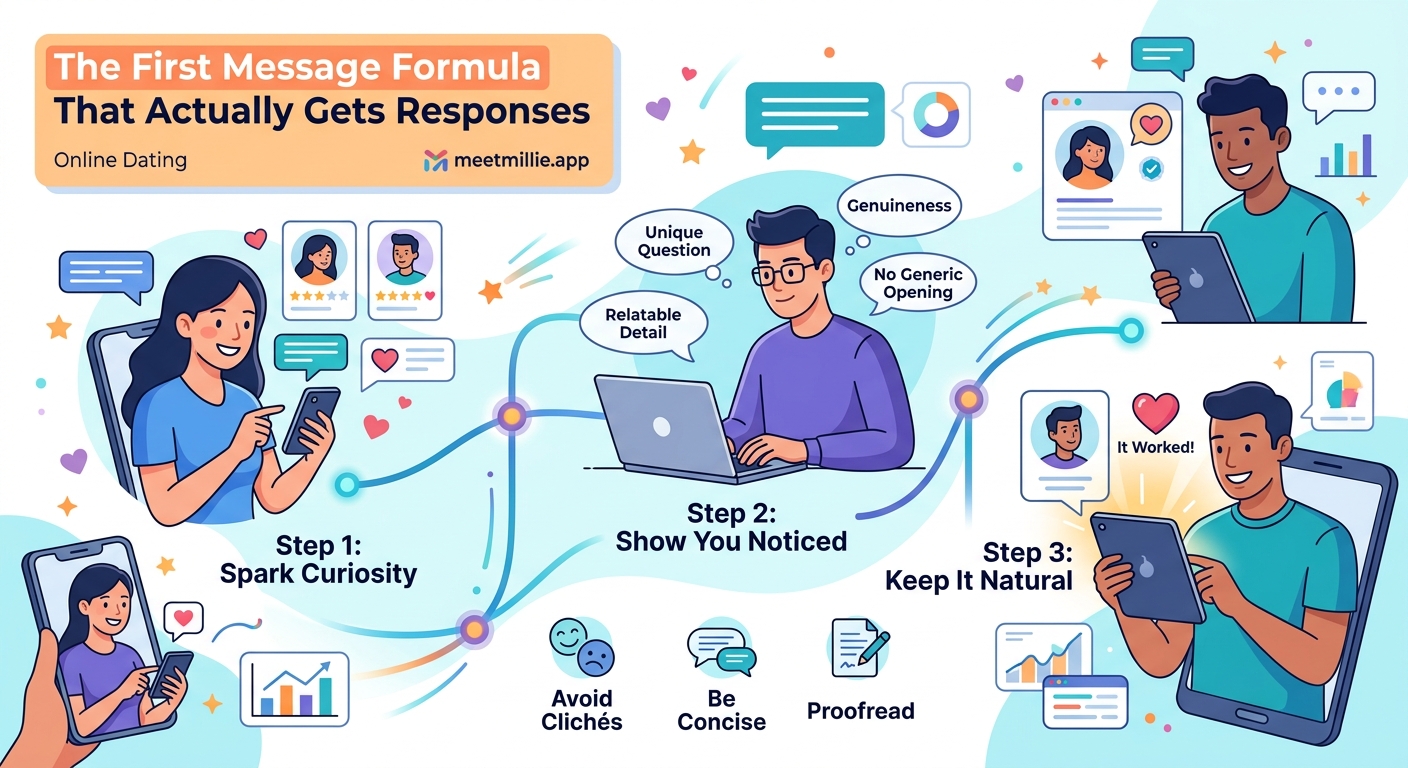
Here is the structure that consistently gets responses across all dating platforms.
Part 1: The specific observation
Find something unique in their profile. Not their eyes or smile. Look for hobbies, travel photos, unusual interests, or details most people skip.
Good examples:
– “I noticed you have a photo at Red Rocks. That venue is incredible for live music.”
– “Your dog looks like he is plotting something in that third photo.”
– “You mentioned loving true crime podcasts. Have you listened to the one about the art heist in Boston?”
Bad examples:
– “You look beautiful.”
– “I love your smile.”
– “You seem interesting.”
The specific observation proves you paid attention. It immediately separates you from the 47 other people who sent “Hey beautiful” that morning.
Part 2: The easy question
Ask something they can answer in two sentences. Make it related to your observation. Avoid yes/no questions.
The question should be easy to answer but interesting enough that they want to. Think about what would make you excited to respond if someone asked you.
Good questions:
– “What was the best show you have seen there?”
– “What is he actually like when he is not camera ready?”
– “Have you gotten into any of the newer series, or are you more of a classic case fan?”
Bad questions:
– “Do you like music?” (Too broad, yes/no)
– “What do you want in a relationship?” (Too intense)
– “Tell me about yourself.” (Lazy, not specific)
Part 3: The personality touch
Add one line that shows your personality. This could be a light joke, a brief personal connection, or a playful observation. Keep it short.
Examples:
– “I am still recovering from the last concert I went to. My ears rang for two days.”
– “My dog has that same expression right before he steals food off the counter.”
– “I binged an entire series last month and now I suspect everyone I meet.”
This final piece makes your message memorable. It gives them a sense of who you are beyond the question.
Putting it all together
Here is what the complete formula looks like in action.
Example 1:
“I noticed you have a photo at Red Rocks. That venue is incredible for live music. What was the best show you have seen there? I am still recovering from the last concert I went to. My ears rang for two days.”
Example 2:
“Your dog looks like he is plotting something in that third photo. What is he actually like when he is not camera ready? My dog has that same expression right before he steals food off the counter.”
Example 3:
“You mentioned loving true crime podcasts. Have you listened to the one about the art heist in Boston? I binged an entire series last month and now I suspect everyone I meet.”
Each message follows the same structure but feels completely different based on the person you are messaging.
Step by step process for writing your first message
Follow these steps every time you match with someone new.
-
Read their entire profile twice. Look at all photos, read the bio completely, check any prompts they answered. Most people skip this. You will not.
-
Identify three specific details. Write them down. These could be places, hobbies, pets, books, shows, sports teams, or anything that shows personality.
-
Pick the detail that interests you most. Choose something you genuinely care about or can relate to. Fake interest shows through immediately.
-
Write your observation sentence. Keep it to one line. Be specific about what you noticed.
-
Create your question. Make sure it requires more than one word to answer. Test it by asking yourself if you could respond with just “yes” or “no.” If you can, rewrite it.
-
Add your personality line. This should be brief and natural. Read it out loud. If it sounds forced, cut it or simplify.
-
Read the whole message once. Does it sound like something you would actually say? If not, adjust the tone.
-
Send it and move on. Do not stare at your phone waiting for a response. Send your message and go do something else. Checking every five minutes makes you anxious and does not speed up their reply.
Common mistakes that kill your response rate
| Mistake | Why it fails | What to do instead |
|---|---|---|
| Starting with a compliment about looks | They hear it constantly, feels generic | Comment on something they chose to share |
| Asking “How was your weekend?” | Boring, requires effort to answer | Ask about something specific from their profile |
| Writing a paragraph about yourself | Overwhelming, feels one-sided | Keep first message under four sentences |
| Using pickup lines | Cheesy, shows you use the same line on everyone | Personalize every single message |
| Apologizing or self-deprecating | Kills confidence before you start | Be friendly and assume they want to talk |
| Asking them out immediately | Too aggressive, skips connection building | Have at least 3-4 message exchanges first |
The biggest mistake is treating your first message like it needs to be perfect. It does not need to be clever or witty or impressive. It just needs to be specific, easy to respond to, and genuine.
What to do after they respond
Getting a response is step one. Keeping the conversation going is step two.
When they reply, read their answer carefully. Look for details you can build on. Ask a follow up question about something they mentioned. Share a related experience of your own.
Keep the ratio balanced. If you ask three questions in a row, you are interviewing them. If you talk about yourself for three messages straight, you are lecturing. Aim for back and forth.
After 5-8 messages, suggest moving the conversation forward. This could mean switching to texting, setting up a video call, or planning to meet in person. Staying on the app too long makes the conversation fizzle out.
When you are ready to take that next step, learning how to stop overthinking every text message you send will help you stay confident as things progress.
Adapting the formula for different situations
The basic structure works everywhere, but you can adjust it based on the platform and person.
For minimal profiles:
If someone has almost nothing in their bio, use their photos. Comment on the location, the activity they are doing, or even their style choices. “That hiking trail in your second photo looks amazing. Where is that?” works better than giving up and sending “Hey.”
For detailed profiles:
When someone writes paragraphs, pick the detail that surprised you most or made you laugh. “I have never met anyone else who collects vintage lunch boxes. How did that start?” shows you actually read everything.
For professionals on LinkedIn or networking apps:
The formula still applies but the tone shifts. “I saw you recently moved into product management at a startup. What made you switch from corporate? I have been thinking about a similar move.” This maintains professionalism while staying personal.
For people with shared interests:
Lead with the connection but add your unique angle. “I noticed you run marathons. I just finished my first half and barely survived. What made you jump to the full distance?” This creates common ground while keeping the conversation open.
Real examples that got responses
These are actual messages that led to conversations and dates.
“You have a photo at that bookstore in Portland. I spent three hours there last summer and left with eight books I did not plan to buy. What is your record for unplanned book purchases?”
Response rate: Replied within two hours, conversation lasted a week, led to a coffee date.
“Your profile says you are learning Spanish. Are you using an app or taking classes? I tried Duolingo for six months and can now order tacos with confidence but nothing else.”
Response rate: Replied same day, exchanged 15+ messages, moved to texting.
“I see you have a cat who clearly runs your household based on that photo. Does he judge all your life choices, or just the important ones? Mine gives me a death stare every time I leave the house.”
Response rate: Replied within an hour, bonded over pet stories, planned a date within three days.
Notice how each message feels different but follows the same structure. Observation, question, personality.
Why this formula works better than everything else
This approach succeeds because it solves the three biggest problems with online dating messages.
Problem 1: Standing out
When someone gets dozens of messages, yours needs to be different immediately. Specific observations about their profile cannot be copied and pasted to other matches. It proves you are talking to them, not just anyone.
Problem 2: Making replying easy
A good question gives them something to respond to without thinking too hard. They can answer in 30 seconds while waiting in line or during a commercial break. Easy responses lead to actual responses.
Problem 3: Showing personality
The brief personal touch gives them a sense of who you are. It makes you feel like a real person, not just another profile. That connection, even tiny, makes them want to keep talking.
The best first messages feel like the start of a conversation you would have in real life, not a formal introduction or a sales pitch. Write like you are talking to someone at a party, not applying for a job.
Testing and improving your messages
Track what works. After sending 20 messages using this formula, look at your response rate.
If you are getting responses but conversations die after a few exchanges, your follow up needs work. If you are not getting responses at all, your observation might be too generic or your question too difficult to answer.
Try variations. Test different types of observations. See if questions about hobbies get better responses than questions about travel. Notice which personality touches feel most natural for you.
The formula gives you structure, but your style makes it work. Some people are naturally funny. Others are thoughtful. Some are direct. Use the formula as a framework and fill it with your actual personality.
When to break the formula
Rules are useful until they are not. Sometimes you should ignore this structure completely.
If someone writes in their bio “Please do not ask me about my dog,” then do not ask about their dog. If they say “Looking for someone who can make me laugh,” lead with something funny instead of an observation.
If you match with someone you already know from real life, skip the formula. “I did not expect to see you on here. How have you been since graduation?” works better than pretending you are strangers.
If their profile is entirely photos with zero bio, you have two choices. Send a message about something visible in the photos, or unmatch and focus on people who put in effort. Both are valid.
The formula works most of the time. Use your judgment for the exceptions.
From first message to first date
A great opening message is just the beginning. Once you have a conversation going, you need to know what comes next.
Pay attention to how engaged they seem. If they are asking questions back and adding details beyond just answering yours, they are interested. If responses get shorter or slower, they might be losing interest or talking to someone else.
Suggest meeting after you have established some rapport but before the conversation gets stale. Usually this happens after 5-10 messages over 2-3 days. “I am enjoying this conversation. Want to continue it over coffee this weekend?” is direct and clear.
Once you set up that first date, thinking about what to wear on a first date and having conversation starters that actually work ready will help you feel prepared and confident.
Making this formula your own
The structure here is a starting point, not a script. Use it until it feels natural, then adapt it to match how you actually communicate.
If you are more reserved, your personality line might be understated. If you are outgoing, it might be bolder. Both work as long as they are genuine.
The goal is not to trick someone into responding. It is to start real conversations with people you are actually interested in. The formula just makes that easier by giving you a proven structure to work from.
Write like yourself. Ask about things you care about. Be someone you would want to talk to. That authenticity matters more than perfect phrasing.
Your next match deserves better than “Hey”
You now have a formula that works. You understand why it works. You know how to adapt it for different situations.
The next time you match with someone interesting, take three minutes to write a real first message. Look at their profile. Find something specific. Ask a genuine question. Add a touch of personality.
That is it. No tricks, no games, no pickup lines. Just a thoughtful message that shows you are interested in them specifically, not just anyone who swiped right.
Your response rate will improve. Your conversations will feel more natural. And you will spend less time wondering why nobody replies and more time actually getting to know people worth meeting.
Start with your next match. Read their profile carefully, apply the formula, and send a message that stands out for the right reasons.