
Heartbreak doesn’t follow a timeline, but healing becomes easier when you have a roadmap. A 30 day breakup challenge gives you structure when everything feels chaotic, purpose when you’re lost, and small victories when you need them most.
A 30 day breakup challenge provides daily actionable steps to process grief, rebuild self-worth, and establish new routines after a relationship ends. Through structured activities like journaling, physical movement, social reconnection, and boundary-setting, you create momentum toward healing. The challenge works because it replaces rumination with action, transforms pain into personal growth, and proves you can survive one day at a time until you’re thriving again.
Why a 30 day structure works for healing
Thirty days is long enough to form new habits but short enough to feel achievable when you’re barely holding it together.
Research shows it takes about three to four weeks to start rewiring your brain’s automatic patterns. When you’re fresh out of a relationship, your mind defaults to thoughts of your ex constantly. A structured challenge interrupts those loops.
The daily format matters too. You’re not staring at months of recovery ahead. You’re just getting through today. Then tomorrow. Then the day after that.
This approach transforms overwhelming grief into manageable tasks. Instead of “get over my ex,” you have “complete today’s challenge.” That shift changes everything.
Breaking down the 30 day breakup challenge
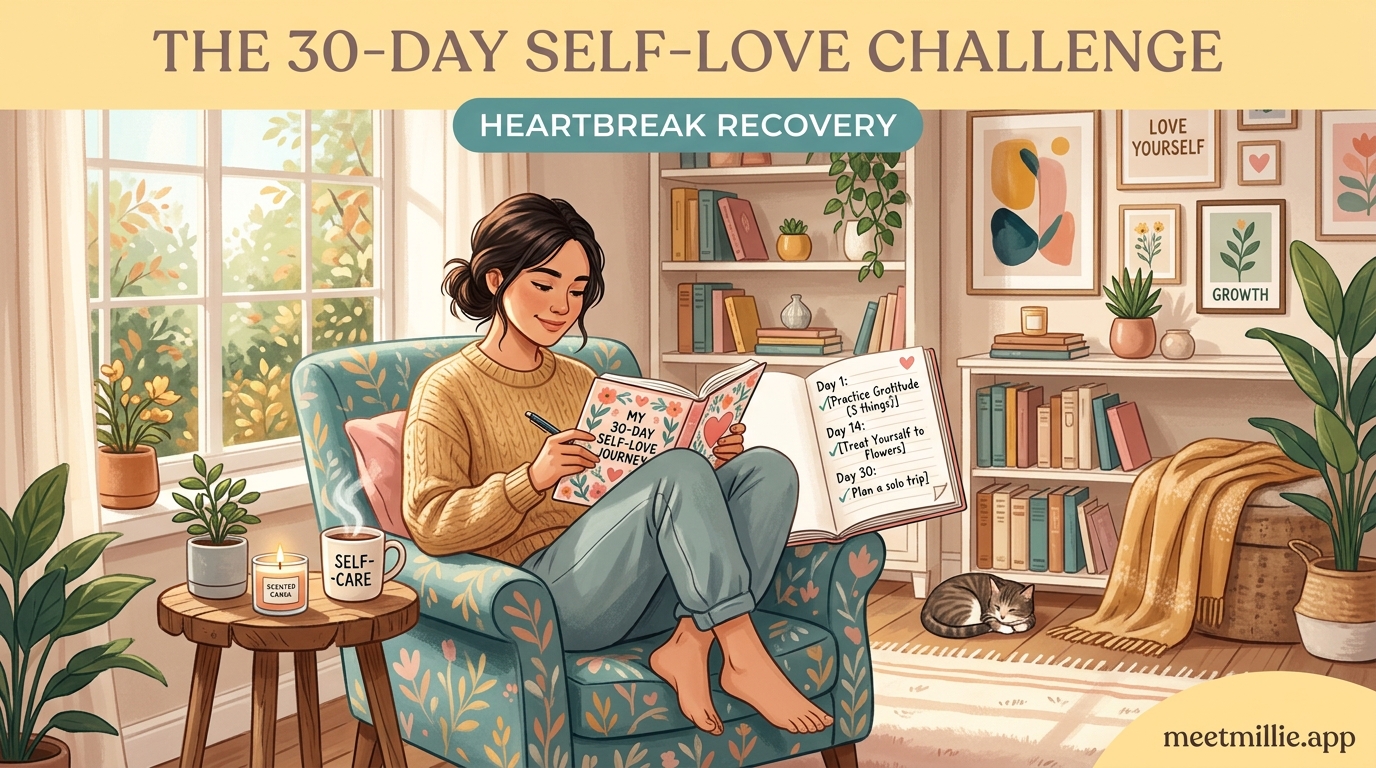
The challenge divides into four distinct phases, each building on the previous week’s work.
Week One: Survival and acknowledgment
Days 1 through 7 focus on simply making it through. You’re not trying to be over it. You’re creating space to feel what you feel.
- Write down everything you’re feeling without editing yourself. Set a timer for 15 minutes and let it pour out.
- Remove or box up items that trigger painful memories. You’re not erasing the past, just creating breathing room.
- Tell three people you trust that you’re struggling. Isolation makes everything worse.
- Move your body for 20 minutes, even if it’s just walking around your block. Physical movement processes emotional pain.
- Establish one new routine that’s entirely yours. A morning coffee ritual. An evening walk. Something that belongs to this new chapter.
- List five things you didn’t like about the relationship. This isn’t about blame but about seeing reality clearly.
- Do something that makes you laugh, even if you have to force yourself. Watch stand-up. Text your funniest friend. Laughter creates tiny cracks in the grief.
Week Two: Rediscovery and rebuilding
Days 8 through 14 shift toward remembering who you are outside the relationship.
- Revisit a hobby you abandoned during the relationship
- Cook yourself a meal you genuinely enjoy
- Update your living space in one small way
- Reach out to a friend you lost touch with
- Try something new, even something tiny like a different coffee shop
- Write a letter to yourself from five years in the future
- Spend an entire day without checking your ex’s social media
Week Three: Growth and boundaries
This week introduces harder work. You’re ready for it.
The focus shifts to establishing what you’ll accept going forward and what you won’t. You’re building the foundation for healthier relationships, starting with the one you have with yourself.
| Day | Challenge | Why It Matters |
|---|---|---|
| 15 | Block your ex on social media | Stops the checking spiral |
| 16 | List your non-negotiables for future relationships | Clarity prevents repeat patterns |
| 17 | Apologize to yourself for ways you abandoned your needs | Self-forgiveness is healing |
| 18 | Do something that scared you in the relationship | Reclaim your autonomy |
| 19 | Write down three lessons from this heartbreak | Pain without growth is just suffering |
| 20 | Plan something to look forward to next month | Hope lives in future plans |
| 21 | Celebrate making it three weeks | Progress deserves recognition |
Week Four: Integration and moving forward
The final stretch isn’t about being “over it” completely. It’s about integration. The breakup becomes part of your story, not the whole story.
Days 22 through 30 prepare you to carry these practices beyond the challenge. You’re building sustainability.
“Healing isn’t linear, and it doesn’t have an expiration date. The goal isn’t to forget what happened but to stop letting it control what happens next. A structured challenge gives you agency when heartbreak tries to convince you that you’re powerless.”
Common mistakes that derail your progress
Knowing what doesn’t work matters as much as knowing what does.
Mistake one: Measuring your healing against someone else’s timeline
Your college roommate got over her ex in two weeks. Your sister took two years. Neither timeline is yours. Comparison adds shame to grief, and shame slows everything down.
Mistake two: Skipping the hard days
Some challenges will feel pointless or too painful. Those are usually the ones you need most. Avoidance creates temporary relief but long-term stuckness.
Mistake three: Treating the challenge like a breakup cure
This isn’t a magic formula that makes you wake up on day 31 completely healed. It’s a framework that gives structure to a messy process. Some days you’ll still cry. That’s not failure.
How to handle setbacks during the challenge

You’ll have a bad day. Maybe several. Here’s how to navigate them without abandoning the entire process.
First, distinguish between a setback and a breakdown. A setback is crying in the grocery store when you hear your song. A breakdown is texting your ex at 2 AM. One is part of healing. The other undermines it.
When you stumble, return to the most basic challenge from week one. Move your body. Write down your feelings. Call someone who gets it. Don’t try to jump back to the advanced work.
Missing a day doesn’t mean starting over. It means you’re human. Pick up where you left off. The challenge doesn’t expire if you take a break.
If you’re consistently unable to complete challenges, that might signal you need professional support. There’s no shame in that. Sometimes heartbreak reveals or triggers deeper issues that need more than a 30 day framework.
What happens after day 30
The challenge ends, but the work continues. That’s not discouraging, it’s realistic.
By day 30, you’ll have established new patterns. Morning routines that don’t involve checking if your ex viewed your story. Evening rituals that don’t include analyzing old text threads. A support system you’ve actively maintained.
These patterns need protection. It’s easy to slip back into old habits when you’re feeling better. Better is when you double down on what got you there.
Consider what you’ll keep from the challenge. Maybe daily journaling stuck. Maybe the weekly social plans became non-negotiable. Build those into your regular life.
You might also be ready to think about dating again, though there’s no pressure. 7 signs you’re actually ready to date again after a breakup can help you figure out if you’re there yet or if you need more time.
Adapting the challenge to your situation
Not every breakup looks the same. A three-year relationship that ended in betrayal requires different processing than a six-month relationship that fizzled out.
If you were married or lived together, add practical challenges around establishing your independent space. Claim the bedroom as yours. Rearrange furniture. Create a home that reflects only you.
If you share children, your challenge needs to account for ongoing contact. Focus extra energy on boundary work and emotional regulation. You can’t go no-contact, but you can control how much mental space the relationship occupies.
If the breakup was your choice, you might face guilt alongside grief. Add challenges that address that specifically. Write about why you made the decision. List what staying would have cost you. Remind yourself that the right choice can still hurt.
Long-distance breakups sometimes feel less “real” because you weren’t physically together often. Don’t minimize your pain. The relationship existed. The loss is valid.
Building your support system during the challenge
You can’t heal in isolation. Humans are wired for connection, and heartbreak often makes us want to hide.
Identify three types of support people before you start. The listener who lets you process without trying to fix anything. The distractor who gets you out of your head with activities. The truth-teller who lovingly calls you out when you’re spiraling.
You need all three. Don’t rely on one person to be everything.
Be specific when you ask for help. “I’m doing a 30 day challenge to get over my breakup and I need someone to check in on me weekly” is better than “I’m going through something.” People want to help but often don’t know how.
Online communities can supplement but not replace real-life support. There’s value in connecting with others going through breakups, but make sure you’re not just trading misery. Look for communities focused on growth, not just venting.
If your support system is thin, building it becomes part of the challenge. Join a class. Volunteer. Show up to that work happy hour. Connection heals, but you have to create opportunities for it.
Tracking your progress without obsessing
Documentation helps you see growth you might otherwise miss. When you’re in it, every day can feel the same. Looking back shows you how far you’ve come.
Keep a simple journal with three prompts: What did I do today? How did I feel? What’s one thing I’m proud of? That’s it. You’re not writing a novel.
Take a photo of yourself on day one and day 30. Not for social media. For you. Your face will look different. Grief shows up in our eyes, and so does healing.
Notice practical changes too. Are you sleeping better? Eating regular meals? Going entire hours without thinking about your ex? These aren’t small things.
Avoid the trap of grading yourself. This isn’t school. Some days surviving is an A+. Other days you’ll accomplish more. Both count.
When the challenge reveals bigger issues
Sometimes a breakup is the earthquake that exposes foundational cracks. Patterns you’ve carried for years. Attachment wounds from childhood. Mental health struggles you’ve been managing alone.
The challenge might bring these to the surface. That’s not a failure of the challenge. It’s the challenge working.
If you notice you’re struggling with more than breakup grief, consider that an invitation to address those deeper issues. Therapy isn’t a sign you’re broken. It’s a tool for building the life you want.
Some red flags that suggest you need professional support: intrusive thoughts that don’t ease over time, inability to function in daily life beyond the first week or two, self-harm urges, complete social withdrawal, or using substances to numb the pain.
The challenge can run alongside therapy. They’re not mutually exclusive. Think of the challenge as daily practice and therapy as the deeper work.
Making room for the person you’re becoming
Heartbreak changes you. That’s not just poetic, it’s neurological. Your brain literally rewires around loss and recovery.
The person you are on day 30 won’t be who you were on day one. She’ll be stronger in some ways, more cautious in others. She’ll know what she won’t tolerate. She’ll have proven to herself that she can survive what she thought would destroy her.
Make room for her. Let go of who you were in the relationship. That version of you served a purpose, but this is a different chapter.
This might mean your friend group shifts. Some people are only comfortable with the old you. That’s information, not rejection.
It might mean your goals change. The life you were building with your ex isn’t the life you’re building now. Grieve that loss too, then get curious about what you actually want.
You might discover you like yourself more now. That’s not betraying the relationship. It’s honoring what you learned from it.
Your first day starts now
Thirty days from now, you’ll be glad you started today. Not because you’ll be completely healed, but because you’ll have 30 days of proof that you’re capable of healing.
The challenge works because it replaces rumination with action. Instead of replaying the breakup in your mind, you’re building something new. Instead of waiting to feel better before you act, you’re acting your way into feeling better.
You don’t need to feel ready. You don’t need to have it all figured out. You just need to do day one. Then day two. Then day three.
The structure holds you when you can’t hold yourself. The daily tasks give you purpose when everything feels pointless. The progress, even tiny progress, reminds you that forward motion is possible.
Start with the first challenge. Write down everything you’re feeling for 15 minutes. Don’t edit. Don’t judge. Just let it out. That’s day one. You can do day one.