
You know that feeling when you replay every awkward moment from last night’s date like it’s a horror movie on loop? The conversation that died mid-sentence. The joke that landed flat. The spinach in your teeth you didn’t notice until you got home.
You’re not alone, and you’re definitely not broken.
Bad first dates happen to everyone. They’re practically a rite of passage in modern dating. The difference between people who keep dating successfully and those who give up isn’t that the successful ones never have terrible dates. They just know how to bounce back without letting one weird evening destroy their confidence.
Recovering from an awkward first date requires perspective, self-compassion, and actionable steps to rebuild confidence. Most dating disasters stem from mismatched expectations or nerves, not personal failure. By reframing the experience, learning what you can control, and getting back out there strategically, you transform embarrassment into growth. One bad date doesn’t define your dating future or your worth as a partner.
Why awkward first dates mess with your head
Your brain treats social rejection like physical pain. That’s not dramatic. That’s neuroscience.
When a first date goes sideways, your amygdala fires up the same distress signals it would if you touched a hot stove. Your mind wants to protect you from future pain, so it replays the embarrassing moments on repeat, trying to identify what went wrong.
This is why you can’t stop thinking about that weird silence when the waiter asked if you wanted separate checks. Or the moment you accidentally called them by your ex’s name.
Your brain thinks it’s helping. It’s not.
The overthinking spiral keeps you stuck. It convinces you that every small mistake was catastrophic. It makes you want to delete all your dating apps and adopt seventeen cats instead.
But here’s what your anxious brain won’t tell you: most people are too worried about their own performance to obsess over yours. That moment you think ruined everything? They probably didn’t even notice it the way you did.
The 24-hour rule for processing what happened
Give yourself one full day to feel whatever you’re feeling.
Embarrassed? Feel it. Disappointed? That’s valid. Angry at yourself for saying that thing about your college roommate’s ferret? Let it wash over you.
But set a timer. Twenty-four hours.
During this window, you’re allowed to:
- Text your best friend the full play-by-play
- Eat comfort food without judgment
- Watch that show that always makes you feel better
- Journal about what happened
- Take a long walk and mentally rehearse what you wish you’d said
What you’re not allowed to do is make any big decisions about your dating life. Don’t delete your profile. Don’t text them a novel-length apology. Don’t swear off dating forever.
After 24 hours, you need to start shifting your perspective. Not because your feelings don’t matter, but because ruminating past this point stops being processing and starts being self-sabotage.
What you can actually control (and what you can’t)
Here’s a reality check that might sting a little: you can’t control chemistry.
You also can’t control whether someone is emotionally available, recently heartbroken, secretly still hung up on their ex, or just having the worst week of their life.
You can’t control traffic that made you 15 minutes late. You can’t control the restaurant being weirdly loud. You can’t control your date’s mood, expectations, or whether they’re even ready to date.
What you can control:
-
Your preparation: Choosing a comfortable venue, having conversation starters that actually work on a first date ready, and knowing what to wear on a first date so you feel confident.
-
Your mindset going in: Managing your expectations and remembering that a first date is just two people seeing if they enjoy each other’s company. Nothing more, nothing less.
-
Your behavior during the date: Being present, asking questions, listening actively, and treating your date with basic respect and kindness.
-
Your response afterward: How you process the experience, what you learn from it, and whether you let it knock you down or build you up.
This distinction matters because beating yourself up over things outside your control is exhausting and pointless.
Breaking down what actually went wrong
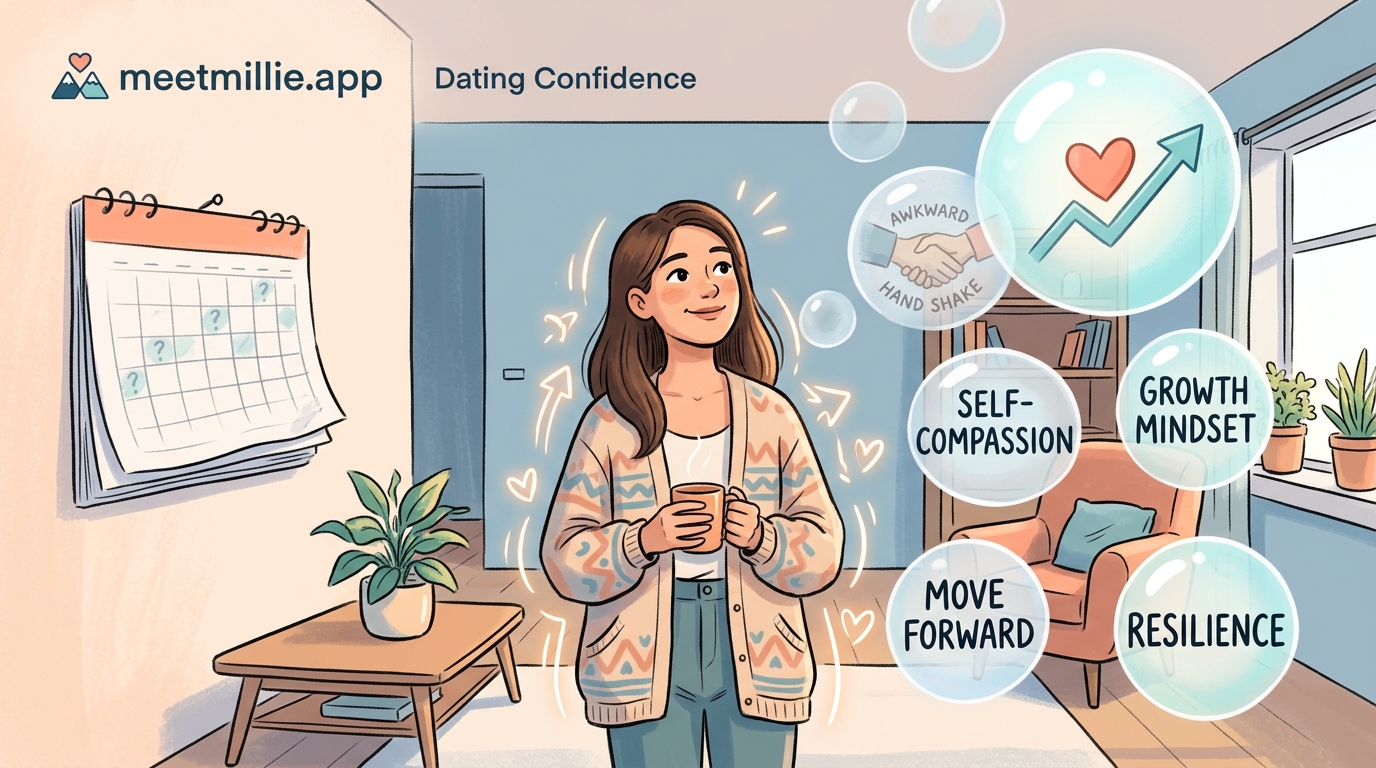
Time for some detective work. Not the obsessive kind. The productive kind.
Get a piece of paper or open a note on your phone. Draw a line down the middle.
On the left side, write “Things that were genuinely awkward.” On the right side, write “Things my anxiety is exaggerating.”
Be ruthlessly honest. Did you actually spill wine on them, or did you just worry about it the whole time? Did the conversation really die, or were there just a few normal pauses?
Now look at your “genuinely awkward” list and ask yourself three questions about each item:
- Was this something I did, something they did, or something neither of us could control?
- If I did it, was it a skill I can improve or just a human mistake anyone could make?
- Would I judge a friend harshly if they did the same thing?
Most of the time, you’ll realize that what felt like a catastrophe was actually just… a normal moment between two nervous humans.
Sometimes you’ll identify real issues. Maybe you talked too much because you were nervous. Maybe you checked your phone out of habit. Maybe you weren’t really present because you were already convinced it wasn’t going well.
Those are useful insights. Write them down. They’re not character flaws. They’re areas where you can make small adjustments next time.
The difference between learning and spiraling
| Learning looks like | Spiraling looks like |
|---|---|
| “I notice I interrupt when I’m nervous. I can work on that.” | “I’m a terrible person who can’t have a normal conversation.” |
| “We didn’t have much in common. That’s okay.” | “Nobody will ever want to date me.” |
| “I should have asked more questions about their interests.” | “I ruined everything by being so self-centered.” |
| “Next time I’ll suggest a quieter venue.” | “I’m too awkward to date anyone ever again.” |
See the difference?
Learning is specific and actionable. Spiraling is global and paralyzing.
Your goal isn’t to become perfect at first dates. Your goal is to become slightly better at recognizing what works for you and what doesn’t.
Maybe you’ve learned that coffee dates make you too jittery. Maybe you’ve realized you need to eat something before a dinner date so you’re not hangry. Maybe you’ve figured out that you do better with activity dates where there’s something to do besides stare at each other.
These insights are gold. They help you set yourself up for success next time.
How to rebuild your confidence in three concrete steps
Confidence isn’t something you either have or don’t have. It’s something you build through action.
Step one: Do something you’re good at
Your dating confidence took a hit. Fine. But you’re still good at other things.
Go do one of those things. Cook that recipe you’ve perfected. Play that video game you always win. Call the friend who thinks you’re hilarious. Work on that project you’re proud of.
This isn’t about avoiding your feelings. It’s about reminding yourself that you’re a whole person with value beyond how one date went.
Step two: Get a small win in the dating world
You don’t need to go on another date tomorrow. But you do need to prove to yourself that you can still take action.
Update one photo on your profile. Send one thoughtful message to a new match. Read about how to stop overthinking every text message you send so you feel more prepared.
Small actions break the freeze response. They remind your nervous system that dating isn’t actually dangerous.
Step three: Rewrite the story you’re telling yourself
Right now, the story in your head probably sounds like: “I had an awful date and humiliated myself and I’ll never recover.”
Try this version instead: “I had an uncomfortable date with someone I wasn’t compatible with. I learned a few things. I’m going to apply those lessons and keep moving forward.”
Same facts. Completely different meaning.
The story you tell yourself becomes your reality. Choose the one that serves you.
When to reach out (and when to let it go)
You’re probably wondering if you should text them.
Here’s the honest answer: it depends on what kind of awkward you’re dealing with.
If the awkwardness was mutual nerves and you actually enjoyed their company despite the weird moments, send a simple text. Something like: “Thanks for meeting up yesterday. I had a good time getting to know you, even if we were both a little nervous. Would you want to try again?”
If they felt the same way, they’ll appreciate your honesty and confidence.
If they don’t respond or give you a polite decline, you have your answer. No harm done.
But if the awkwardness came from a fundamental mismatch, or if you noticed first date red flags you shouldn’t ignore, let it go.
Not every connection deserves a second chance. Sometimes the awkwardness is your intuition telling you this person isn’t right for you.
Trust that feeling.
And whatever you do, don’t send a long apology text for being “weird” or “awkward” or “not yourself.” That just makes things more uncomfortable and puts the other person in the position of having to reassure you.
The post-first-date text should be light, confident, and brief. If you can’t manage that right now, it’s okay to wait.
Getting back out there without the baggage
The best way to get over a bad date is not to pretend it didn’t happen. It’s to prove to yourself that one awkward experience doesn’t define your entire dating life.
But don’t rush it. You don’t need to have three dates lined up by next weekend to prove you’re resilient.
Take the time you need to process. Then, when you’re ready, start fresh with intention.
Before your next date, try this mental reset:
- Remind yourself that this is a different person in a different situation
- Set realistic expectations (you’re meeting a stranger, not your soulmate)
- Focus on having an interesting conversation, not on being perfect
- Choose a venue where you’ll feel comfortable and confident
- Have a plan for how long should a first date last so you’re not stuck if things aren’t clicking
Most importantly, remember that you’re not trying to make them like you. You’re trying to figure out if you like them.
That shift in perspective changes everything. Suddenly you’re not performing. You’re evaluating. You have power in this situation.
“Dating confidence doesn’t come from never having bad dates. It comes from knowing you can handle bad dates and still show up as yourself the next time.” – Dr. Sarah Mitchell, relationship psychologist
The awkward dates that taught you something valuable
Think about the worst date you’ve ever had before this one.
Can you even remember all the details anymore? Probably not.
What you probably do remember is what you learned from it. Maybe you learned that you need to be more selective about who you agree to meet. Maybe you learned that you’re braver than you thought. Maybe you learned that you can survive embarrassment and come out fine on the other side.
This recent awkward date will eventually become just another data point in your dating history. A funny story you tell friends. A moment that taught you something about what you want or don’t want.
But only if you let it be that instead of turning it into evidence that you’re not cut out for dating.
You are cut out for dating. You just had one weird evening. That’s all.
Your next first date will be different
Not because you’ll be perfect. Because you’ll be more experienced.
You’ll know how to recognize when the nerves are just nerves and when they’re a sign of incompatibility. You’ll have better questions ready. You’ll be more comfortable with silence. You’ll know what you’re looking for and what you’re not willing to settle for.
Every awkward date is practice. Every weird moment is information. Every time you show up despite being nervous, you’re building the kind of confidence that doesn’t crumble the first time something goes wrong.
That’s the confidence that actually matters. Not the kind that requires everything to go perfectly. The kind that says, “I can handle whatever happens, and I’ll be okay either way.”
You’re building that right now, even if it doesn’t feel like it.
The fact that you’re reading this, looking for ways to process and move forward instead of just giving up, tells me you’re going to be fine. Better than fine.
You’re going to have more awkward dates. Everyone does. But you’re also going to have great ones. Ones where the conversation flows easily. Ones where you laugh until your face hurts. Ones where you walk away thinking, “I want to see them again.”
Those dates are coming. This awkward one was just clearing space for them.