
You’ve been with your partner for years. You know their coffee order, their favorite show, the way they hum when they’re happy. But lately, something feels off. The spark isn’t quite there. Dinner conversations feel predictable. Date nights feel more like obligations than adventures. And you’re starting to wonder if something is seriously wrong.
Feeling bored in a long term relationship is completely normal and doesn’t mean your relationship is doomed. Research shows most couples experience periods of monotony after the honeymoon phase ends. The difference between healthy boredom and a real problem lies in whether you still feel emotionally connected, whether you’re both willing to invest effort, and whether the relationship still aligns with your values and goals.
Why boredom happens in committed relationships
Your brain is wired to crave novelty. New experiences trigger dopamine, the feel good chemical that makes everything feel exciting and fresh. When you first started dating your partner, everything was new. Their stories, their habits, the way they kissed you goodnight.
But our brains adapt. Scientists call it hedonic adaptation. The same experience that once thrilled you becomes baseline normal. This isn’t a flaw in your relationship. It’s basic human psychology.
Long term relationships naturally settle into routines. You develop patterns. Friday night takeout. Sunday morning pancakes. The same grocery store run every week. These routines create stability and comfort, but they also create predictability.
And predictability, while comforting, can feel boring.
The transition often happens around the two year mark, though it varies widely. Some couples feel it earlier. Others maintain novelty for years. How to know when your relationship has outgrown the honeymoon phase (and why that’s actually good) can help you understand this shift.
The difference between normal boredom and a dying relationship
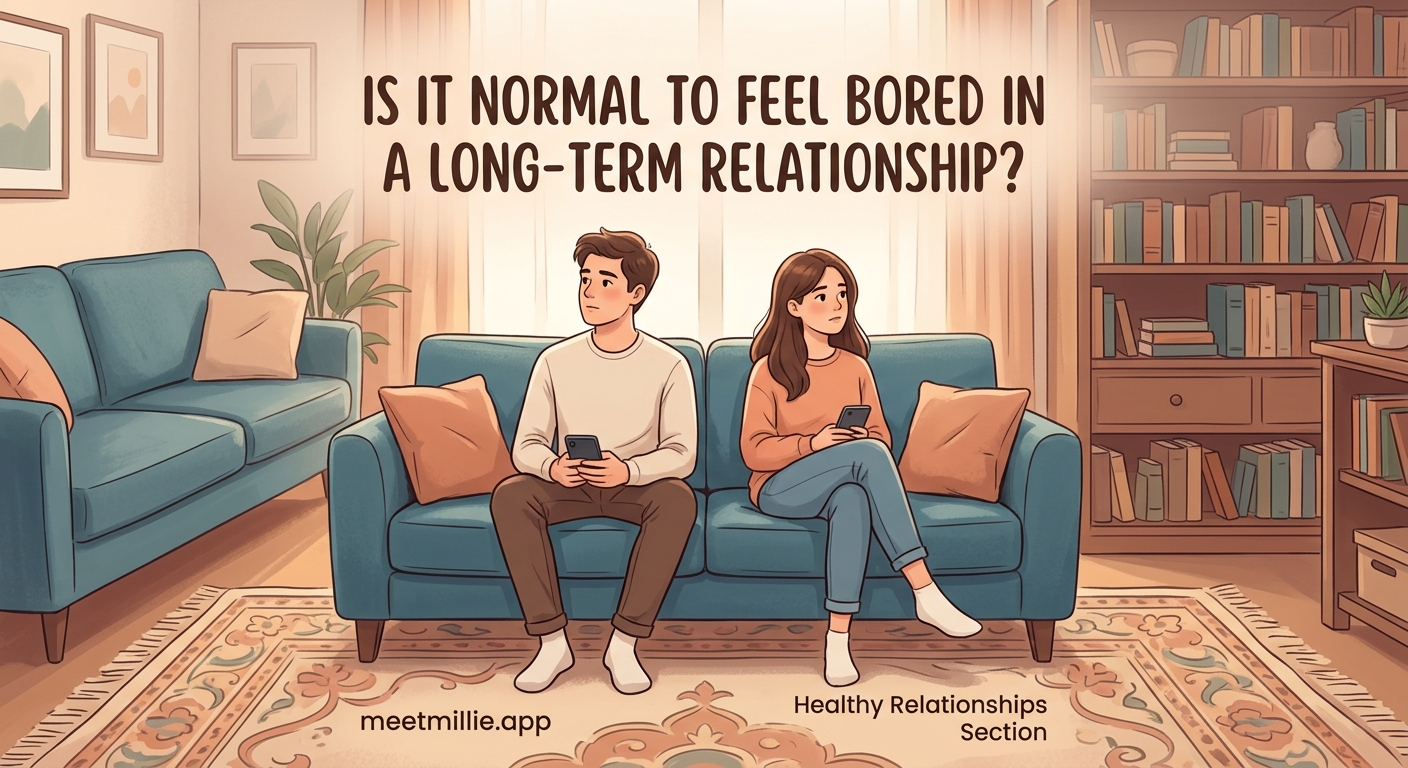
Not all boredom signals trouble. But some does. Here’s how to tell the difference.
Normal, healthy boredom looks like:
- You feel comfortable and safe, just not constantly excited
- You still enjoy spending time together, even if it’s low key
- You’re willing to try new things when one of you suggests them
- You still feel emotionally connected and understood
- Physical affection still feels natural and welcome
- You can talk openly about feeling stuck in a rut
- You both want to make things better
Warning sign boredom looks like:
- You actively avoid spending time together
- You feel relief when they leave for work or trips
- You fantasize about being single or with other people constantly
- Physical touch feels forced or uncomfortable
- You can’t remember the last deep conversation you had
- One or both of you has stopped trying entirely
- You feel lonely even when you’re together
The key difference? Connection. Healthy boredom happens when life gets routine but your bond stays strong. Problem boredom happens when the emotional foundation starts cracking.
What the research actually says
Studies on long term relationships reveal some reassuring patterns. A 2019 study published in the Journal of Social and Personal Relationships found that relationship satisfaction naturally dips after the honeymoon period, then stabilizes. This dip doesn’t predict breakup. Most couples who push through this phase report high satisfaction later.
Another study from the University of Denver tracked couples over 20 years. Researchers found that feeling bored wasn’t a strong predictor of divorce. What mattered more was how couples responded to boredom. Couples who actively worked to inject novelty and maintain friendship stayed together. Those who ignored the problem or blamed each other didn’t.
“Boredom in relationships is like hunger. It’s a signal, not a crisis. It tells you something needs attention, but it doesn’t mean the whole system is broken.” (Dr. Arthur Aron, relationship researcher)
The science is clear. Boredom is normal. Your response to it matters more than the boredom itself.
Common causes of relationship boredom
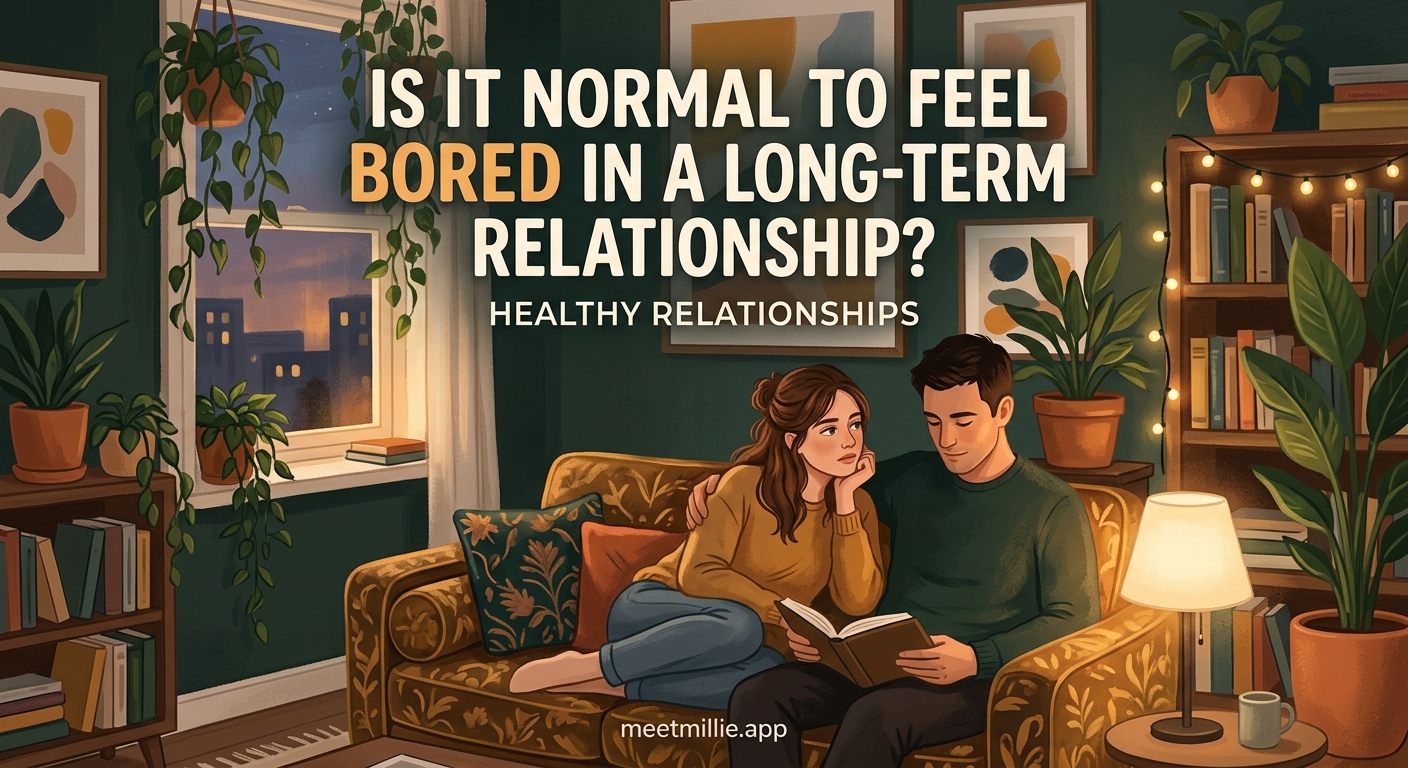
Understanding why you’re bored helps you fix it. Here are the most common culprits.
Life stress eating your energy
When work is overwhelming, when you’re dealing with family issues, when money is tight, you have less energy for romance. Your relationship becomes functional. You coordinate schedules, split chores, handle logistics. The fun stuff falls away.
This isn’t about loving your partner less. It’s about running on empty.
Losing your individual identity
Some couples merge too completely. You do everything together. You share all the same friends. You have no separate hobbies. This sounds romantic, but it kills novelty. You have nothing new to bring to conversations because you’ve experienced everything together.
Healthy relationships need some separation. Individual growth creates things to share.
Unresolved conflict creating distance
Sometimes boredom is actually avoidance. You’re not bored. You’re disconnected because there’s an issue you’re both ignoring. Maybe it’s about money. Maybe it’s about future plans. Maybe it’s about something that happened months ago that you never fully resolved.
The “boredom” is actually emotional distance wearing a disguise.
Stopped dating each other
You got comfortable. You stopped planning special things. You stopped dressing up. You stopped flirting. You treat each other like roommates instead of romantic partners.
This happens gradually. One skipped date night becomes two, then ten, then you can’t remember the last time you went out.
How to diagnose what’s really happening
Follow these steps to understand your specific situation.
-
Track your feelings for two weeks. Write down when you feel bored, what you were doing, and what you were thinking. Patterns will emerge. Maybe you’re only bored during certain activities. Maybe it’s worse when you’re stressed. Data helps.
-
Have an honest conversation with your partner. Use “I” statements. “I’ve been feeling like we’re stuck in a routine” works better than “You’re boring.” See how they respond. Are they defensive? Relieved? Willing to work on it? Their reaction tells you a lot.
-
Assess your emotional connection separately from excitement. Close your eyes. Think about your partner. Do you feel warm? Safe? Loved? Or do you feel nothing? Emotional connection can exist without constant excitement. Lack of connection is the real problem.
-
Consider your life context. Are you bored with everything right now, or just your relationship? Depression, burnout, and major life transitions can make everything feel dull. Sometimes the relationship isn’t the problem. Your mental health is.
-
Imagine your future. Picture yourself in five years. Is your partner there? Does that thought make you happy, sad, or neutral? Your gut reaction matters.
What to do when boredom is normal and fixable
If your diagnosis reveals healthy boredom, you have lots of options. These strategies work when the foundation is solid but the surface feels stale.
| Strategy | Why It Works | Common Mistake to Avoid |
|---|---|---|
| Try new activities together | Creates shared novel experiences that trigger dopamine | Forcing activities one person hates; novelty shouldn’t mean misery |
| Develop separate hobbies | Gives you new things to talk about and prevents identity merger | Using separate time as avoidance or creating so much distance you never connect |
| Schedule regular date nights | Ensures romance doesn’t get crowded out by logistics | Making dates feel like chores; keep them fun, not obligatory |
| Change your physical environment | New settings create freshness even in familiar interactions | Spending money you don’t have; novelty can be free |
| Learn something together | Joint growth creates bonding and gives you shared goals | Picking something too hard that creates frustration instead of fun |
| Increase physical affection | Touch releases oxytocin and rebuilds intimacy | Forcing it when there’s unresolved conflict underneath |
Start small. You don’t need a European vacation to fix boredom. You need intention.
Cook a new recipe together on Tuesday. Take a different route on your evening walk. Ask each other questions you’ve never asked before. What’s your partner’s love language? A simple guide to finding out can spark conversations that reveal new layers.
Practical exercises that actually work:
- The “36 questions” exercise: Psychologist Arthur Aron developed 36 questions designed to create intimacy. Work through them over several date nights.
- Weekly “state of us” check ins: Spend 20 minutes every Sunday talking about how you’re feeling about the relationship. Keep it judgment free.
- Monthly adventure rule: Once a month, do something neither of you has done before. It doesn’t need to be expensive. Visit a new neighborhood. Try a new restaurant. Attend a free community event.
- Gratitude sharing: Every night before bed, tell each other one specific thing you appreciated about them that day. This rewires your brain to notice the good.
When boredom signals something deeper
Sometimes boredom is a symptom of a larger issue. Here’s when to take it more seriously.
You need to address underlying problems if:
- You’ve tried multiple strategies and nothing helps
- Your partner refuses to acknowledge the problem or make any effort
- You feel more excited about literally anything else than spending time with them
- You’re staying out of obligation, not desire
- You’ve lost respect for your partner
- Your values have diverged significantly
- There’s been a major trust violation you can’t get past
These situations need different solutions. Sometimes that’s couples therapy. Sometimes it’s individual therapy to work through your feelings. Sometimes it’s accepting that the relationship has run its course.
Not every relationship is meant to last forever. Growth sometimes means growing apart. That’s painful but valid.
If you’re questioning whether to stay or go, what to do when you still love your ex but know you shouldn’t go back offers perspective on making hard decisions, even though your situation is different.
The role of expectations in relationship boredom
Your expectations shape your experience. If you expect constant butterflies and nonstop excitement, you’ll always be disappointed. No relationship maintains that intensity forever.
But if you expect comfortable companionship with occasional sparks, you’ll feel satisfied with a healthy long term relationship.
Many people grew up on romantic comedies and love songs that promise eternal passion. Real relationships look different. They’re quieter. More stable. Less dramatic.
This doesn’t mean settling for unhappiness. It means adjusting your definition of a good relationship to match reality instead of fiction.
Ask yourself: What do I actually need from this relationship? Not what movies told me to want. What makes me feel loved, supported, and fulfilled?
Sometimes boredom comes from chasing the wrong things.
Questions to ask yourself regularly
Self reflection prevents small issues from becoming big ones. Check in with yourself monthly using these questions.
- Do I still like my partner as a person, separate from loving them?
- Am I putting in effort, or just expecting them to fix my boredom?
- What have I done this month to contribute to our relationship?
- Am I comparing our relationship to others’ highlight reels?
- What would make me feel more connected this week?
- Am I avoiding hard conversations that need to happen?
- Do I feel appreciated and valued?
- Am I showing appreciation and value?
Honest answers guide you toward the right actions.
Boredom isn’t the enemy
Feeling bored in your long term relationship doesn’t make you a bad partner. It doesn’t mean you’ve failed. It means you’re human.
Every long term couple faces this. The ones who make it aren’t the ones who never get bored. They’re the ones who treat boredom as a signal to reconnect, not a reason to quit.
Your relationship is a living thing. It needs attention, effort, and occasional renewal. But it doesn’t need to feel like a romantic comedy every single day.
If you still care about your partner, if you still want to build a life together, if you’re both willing to try, boredom is just a phase. A fixable one.
Start with one small change this week. Have one real conversation. Try one new thing together. See what happens.
The relationship you want is probably closer than you think.