
You know that feeling when you walk into a room and someone just radiates confidence? The kind of person who seems comfortable in their own skin, makes eye contact easily, and doesn’t second-guess every word they say? That energy doesn’t come from magic. It comes from how they start their day.
Your morning sets the tone for everything that follows. Including how you show up on dates, respond to matches, and handle rejection. A solid 10 minute morning routine for confidence can completely change your dating game without requiring you to wake up at 5 AM or become a different person.
A focused 10 minute morning routine for confidence combines physical movement, intentional mindset work, and self-affirmation to build the inner strength needed for dating success. This routine primes your nervous system, strengthens your self-image, and creates consistent momentum that translates directly into how you show up in romantic situations. No complicated protocols or hour-long commitments required.
Why mornings matter more than you think for dating confidence
Your brain is most malleable in the first hour after waking. Neuroscientists call this the hypnagogic state, where your mind transitions from sleep to full consciousness. During this window, you’re more receptive to new patterns and less guarded by your usual defenses.
This matters for dating because confidence isn’t about faking it. It’s about genuinely feeling secure in who you are. When you practice that feeling first thing in the morning, before the day throws curveballs at you, it sticks.
Most people scroll their phones immediately after waking up. They check texts, dating apps, emails, and Instagram before their feet hit the floor. This hands control of their emotional state to external factors. Someone didn’t text back? Day ruined. A match unmatched? Confidence shattered.
The 10 minute morning routine for confidence flips this script. You take control of your state before anything else can influence it.
The complete 10 minute confidence routine

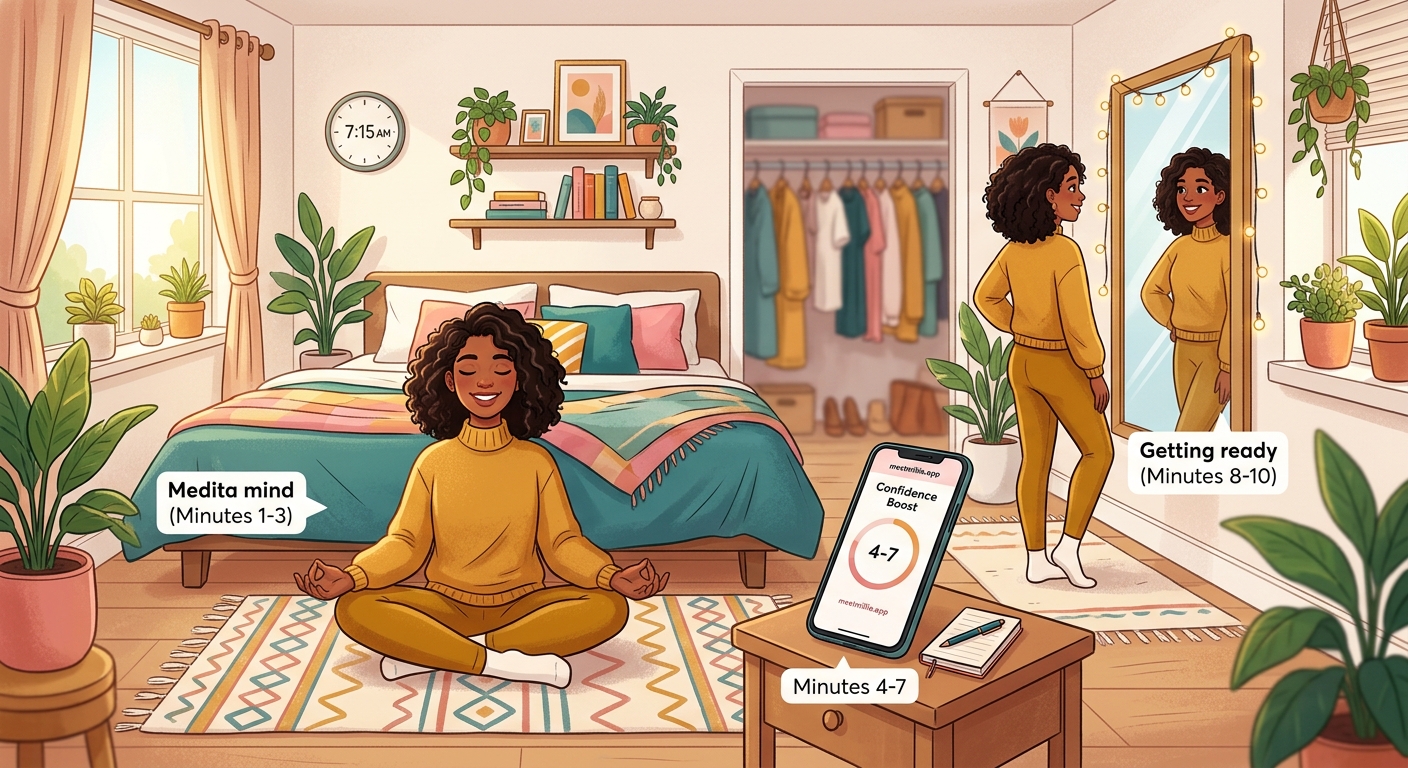
Here’s exactly how to structure your morning for maximum impact. Each step builds on the previous one, creating a compound effect that lasts throughout your day.
Minutes 1-3: Physical reset
Start with movement that wakes up your body and shifts stagnant energy. You’re not training for a marathon. You’re signaling to your nervous system that you’re safe, capable, and ready.
Try this sequence:
- Stand up and stretch your arms overhead, reaching as high as you can
- Roll your shoulders back five times, then forward five times
- Do 10 jumping jacks or high knees to get your heart rate up
- Finish with three deep breaths, inhaling for four counts and exhaling for six
The exhale being longer than the inhale activates your parasympathetic nervous system. This tells your body you’re not in danger, which is the foundation of genuine confidence.
Minutes 4-6: Mindset anchoring
Sit down somewhere comfortable. Close your eyes. Think about a moment when you felt completely confident. Not fake confidence or bravado. Real, grounded certainty in yourself.
Maybe it was when you nailed a presentation at work. Or when you made your friends laugh so hard they cried. Or when you helped someone solve a problem and they looked at you with genuine gratitude.
Relive that moment in detail. What did you see? What sounds were around you? How did your body feel? What was the temperature? The more sensory detail you can recall, the more your brain treats this as a current experience rather than a memory.
This isn’t positive thinking. It’s evidence-based confidence building. You’re reminding your brain that you already have proof of your capability. You’ve done hard things before. You can do them again.
Minutes 7-9: Verbal affirmation with a twist
Most affirmations fail because they feel like lies. Telling yourself “I’m the most attractive person alive” when you don’t believe it creates cognitive dissonance, not confidence.
Instead, use affirmations framed as questions. Your brain loves answering questions and will automatically search for evidence.
Say these out loud, standing in front of a mirror:
- “Why am I becoming more confident every day?”
- “What makes me interesting to talk to?”
- “How do I make people feel comfortable around me?”
Your brain will start generating answers. Maybe you’re becoming more confident because you’re doing this routine. Maybe you’re interesting because you just started learning guitar. Maybe people feel comfortable because you actually listen instead of waiting for your turn to talk.
The answers matter less than the fact that your brain is actively looking for proof of your worth.
Minute 10: Intention setting
Before you start your day, set one specific intention for how you want to show up. Not a goal like “get three matches” or “schedule a date.” Those are outcomes you can’t fully control.
Instead, focus on how you want to be:
- “Today I’ll make eye contact and smile at people I pass”
- “I’ll send one message without overthinking it”
- “I’ll say what I actually think instead of what I think people want to hear”
Write it down. Put it somewhere you’ll see it during the day. Your phone lock screen works great.
Common mistakes that sabotage your morning routine
Even with the best intentions, people mess up their morning routines in predictable ways. Here’s what to avoid and what to do instead.
| Mistake | Why it fails | Better approach |
|---|---|---|
| Checking your phone first thing | Gives external factors control of your mood before you’ve built your own foundation | Keep phone across the room, do routine before touching it |
| Skipping on weekends | Inconsistency prevents habit formation and undermines confidence gains | Do a shortened version on weekends if needed, but never skip completely |
| Making it too complicated | Elaborate routines create friction and excuses to quit | Stick to 10 minutes, same sequence every day |
| Doing it half-heartedly | Going through motions without presence wastes the neurological benefits | Set a timer, close the door, treat it like a meeting you can’t miss |
| Expecting instant results | Confidence builds through repetition, not overnight transformation | Commit to 30 days before evaluating effectiveness |
The biggest mistake? Thinking this routine is separate from your dating life. It’s not. This is your dating life. How you treat yourself in private determines how you show up in public.
How this routine translates to real dating situations
You might be wondering how 10 minutes of morning movement and affirmations helps when you’re sitting across from someone attractive, trying not to say something stupid.
Here’s the connection.
When you practice feeling confident in a controlled environment every morning, you’re literally rewiring your brain’s default state. Neuroscience calls this neuroplasticity. You’re making confidence your baseline instead of anxiety.
So when you’re on a date and there’s an awkward silence, your brain doesn’t immediately jump to “I’m boring and they hate me.” It stays calm. You remember that you’re capable. You’ve felt that certainty before. You can access it now.
The same applies to conversation starters that actually work on a first date. When you’re grounded in your own worth, you’re not desperately trying to impress someone. You’re genuinely curious about them. That shift in energy changes everything.
Or when you’re deciding what to wear on a first date, you’re not obsessing over looking perfect. You’re choosing something that makes you feel like yourself. Because you’ve already established that yourself is enough.
The science behind why this actually works
Let’s talk about what’s happening in your brain when you do this routine consistently.
Your amygdala is the part of your brain responsible for threat detection. When you feel anxious about dating, your amygdala is hyperactive, scanning for danger. Every text takes too long to come through? Danger. They didn’t laugh at your joke? Danger.
Morning routines that combine physical movement, visualization, and affirmation help regulate amygdala activity. You’re teaching your brain that not everything is a threat.
Meanwhile, your prefrontal cortex, the rational part of your brain, gets stronger. This is the part that can pause before you send that desperate follow-up text. The part that can stop overthinking every text message you send.
“Confidence isn’t about never feeling afraid. It’s about having a stronger relationship with the part of your brain that can handle fear without being controlled by it.” – Dr. Andrew Huberman, neuroscientist
The routine also impacts your cortisol levels. Cortisol is your stress hormone. It naturally peaks in the morning. If you immediately check your phone and see something stressful, your cortisol spikes even higher and stays elevated all day.
But if you move your body, breathe deeply, and set positive intentions first, you blunt that cortisol spike. You start the day from a calmer baseline. This affects everything from your posture to your tone of voice to how you interpret ambiguous situations.
What to do when you miss a day
You will miss a day. Maybe you’re traveling. Maybe you had a terrible night’s sleep. Maybe you just forgot.
Don’t spiral. Don’t decide the whole thing is pointless. Don’t abandon the routine because you broke your streak.
Just start again the next morning.
Confidence isn’t about perfection. It’s about consistency over time. Missing one day doesn’t erase the neural pathways you’ve been building. But using one missed day as an excuse to quit definitely will.
If you know you have a chaotic morning coming up, do a condensed version. Even three minutes of intentional breathing and affirmation is better than nothing. The act of showing up for yourself, even imperfectly, reinforces the identity shift you’re trying to create.
Building on the foundation
Once this 10 minute morning routine for confidence becomes automatic (usually after about three weeks), you can start layering in additional practices.
Some people add journaling. Three sentences about what they’re grateful for or what they’re looking forward to. This further trains the brain to notice positive aspects of life instead of fixating on what’s wrong.
Others add a cold shower. The discomfort builds resilience and proves to yourself that you can do hard things. That proof carries over into dating situations that feel uncomfortable.
Some people use the routine as a launchpad for bigger changes. They realize that if they can commit to 10 minutes every morning, they can commit to other things that scare them. Like actually sending that first message. Or suggesting a specific date instead of endless texting.
The routine becomes evidence of your reliability to yourself. And that’s what confidence really is. Knowing that you’ll show up for yourself, even when it’s hard.
Adjusting the routine for your personality
Not everyone’s brain works the same way. If you’re naturally introverted, you might need more quiet reflection and less physical intensity. If you have ADHD, you might need more movement and variety to stay engaged.
Here are some variations that maintain the core principles while adapting to different needs:
-
For introverts: Replace jumping jacks with gentle yoga stretches. Extend the visualization time to five minutes. Keep affirmations internal rather than spoken aloud.
-
For extroverts: Add music to the movement section. Record your affirmations as voice memos and play them back. Call a friend after the routine to share your intention for the day.
-
For analytical types: Track your mood before and after the routine in a simple spreadsheet. The data will motivate you to continue.
-
For creative types: Draw or doodle your intention instead of writing it. Use metaphors in your affirmations. Visualize your confident self as a character in a story.
The structure stays the same. The flavor can change.
When confidence starts showing up in unexpected places
After a few weeks of this routine, you’ll notice shifts that have nothing to do with dating.
You’ll speak up in meetings more easily. You’ll set boundaries with friends without guilt. You’ll make decisions faster because you trust yourself more.
These aren’t side effects. They’re the whole point.
Dating confidence isn’t a separate skill. It’s general life confidence applied to romantic situations. When you feel secure in yourself across all areas, that security naturally shows up when you’re getting to know someone new.
You might even notice that dating anxiety decreases. Not because you’ve eliminated all nervousness, but because you’ve built a foundation strong enough to handle it.
Your morning routine is your secret weapon
Nobody else needs to know you’re doing this. You don’t need to post about it or tell your dates about your morning affirmations.
This is your private practice. Your daily deposit into the confidence bank account.
And unlike external validation, which can be taken away at any moment, this is something you control completely. No one can stop you from doing these 10 minutes. No one can take away the neural changes you’re creating.
That’s real power. Not the kind that dominates others, but the kind that keeps you steady when everything else feels uncertain.
The dating world can be chaotic. Matches disappear. Plans fall through. Chemistry doesn’t always translate from text to in-person. You can’t control any of that.
But you can control your morning. And that might be the most important dating skill of all.
Start tomorrow. Set your alarm 10 minutes earlier. Keep your phone across the room. Move your body, anchor your mind, affirm your worth, and set your intention.
Do it again the next day. And the next. Watch what happens when you stop waiting for confidence to find you and start building it yourself, one morning at a time.