You swipe right. You chat. You meet for coffee. And within ten minutes, you realize this person is nothing like the version of themselves they presented online. It is a frustrating cycle, and it is one of the most common complaints in modern dating. The good news is that the profile itself often contains all the clues you need to avoid that disappointment. You just have to know where to look. Learning how to decode a dating app profile is the single most useful skill you can develop to save time, protect your energy, and actually find someone who shares your core values.
Decoding a dating profile is about reading between the lines. Photos reveal lifestyle priorities, prompts expose communication styles, and bio choices signal emotional availability. This guide gives you a repeatable system to spot compatibility markers before you match, so you stop wasting time on people who look good on paper but feel wrong in person.
Start With the Photos: They Tell a Story Before the Bio Does
Most people swipe based on photos alone. That is a mistake. But photos are still the most data-rich part of any profile. The trick is to stop looking at attractiveness and start looking for clues about a person’s actual life.
Look for these signals in every photo set:
- Group shots without context. If every photo includes friends but you cannot tell which person is the profile owner, that is a red flag. It often signals someone who is not fully owning their presence on the app.
- Vacation photos without substance. A single travel photo is fine. Five travel photos with no shots of everyday life might mean someone is more in love with the idea of a lifestyle than with building a real connection.
- Missing smiles. Genuine smiles (the kind that reach the eyes) are linked to higher emotional openness. If every photo is a serious model pose, you are likely looking at someone who values appearance over authenticity.
- Hobby photos that match your values. This is the green flag zone. If you value health, a hiking shot is great. If you value creativity, a photo of someone painting or playing music tells you more than a paragraph of text.
A good rule of thumb is the three-photo test. If you can look at three of their photos and guess at least two things about their daily life, the profile is working. If you cannot, the person might be hiding more than they are showing. For more help on this, check out our guide on why your dating app photos are scaring away great matches (and how to fix them).
The Bio Is a Map of Priorities (If You Know How to Read It)
A bio is rarely written by accident. Every word choice, every joke, and every omission tells you something about what the person values. The key is to read for substance, not for style.
Here is a list of things to scan for in any bio:
- Specificity over generalities. “I like coffee and travel” tells you nothing. “I spend Sunday mornings at a local roastery and I am planning a trip to the Pacific Northwest this fall” tells you about their routines and their curiosity.
- Negativity disguised as honesty. “I hate drama” is a warning sign. So is “If you cannot handle my sarcasm, swipe left.” These phrases often signal someone who is proud of behaviors that make relationships harder.
- Mention of values, not just hobbies. Words like “family,” “growth,” “kindness,” or “community” are value markers. Words like “Netflix,” “whiskey,” and “adventure” are hobby markers. Both are fine, but a bio with no value markers is harder to decode.
- How they talk about what they want. Someone who writes “Looking for a partner in crime” is different from someone who writes “Looking for someone to build a quiet, happy life with.” Both are valid, but they point to very different relationship goals.
If you are unsure whether a bio is genuine, try this mental test. Read it out loud. Does it sound like something a real person would say to a friend? Or does it sound like a marketing pitch? Trust your ear on this one.
Prompts Are the Hidden Goldmine
Most people treat prompts as an afterthought. They pick the easiest question and give a one-word answer. But prompts are actually the most revealing part of a profile because they force the person to be specific.
Look for how they answer prompts about their ideal weekend, their favorite local spot, or the last thing that made them laugh. These answers reveal emotional temperature.
- A detailed answer shows investment. Someone who writes “My perfect Saturday is a farmers market run, a long bike ride, and tacos from that place on 5th Street” is showing you their life. They are also showing you that they put effort into their profile.
- A vague answer shows low effort. “I like having fun” is not a prompt answer. It is a placeholder. People who treat prompts this way often treat relationships the same way.
- Humor can be a shield or a bridge. Playful answers are great. Answers that rely on sarcasm or self-deprecation might indicate someone who is not ready to be vulnerable.
For a deeper look at how to use these insights once you match, read our article on 7 conversation starters that actually work on a first date.
A Practical System for Decoding Any Profile
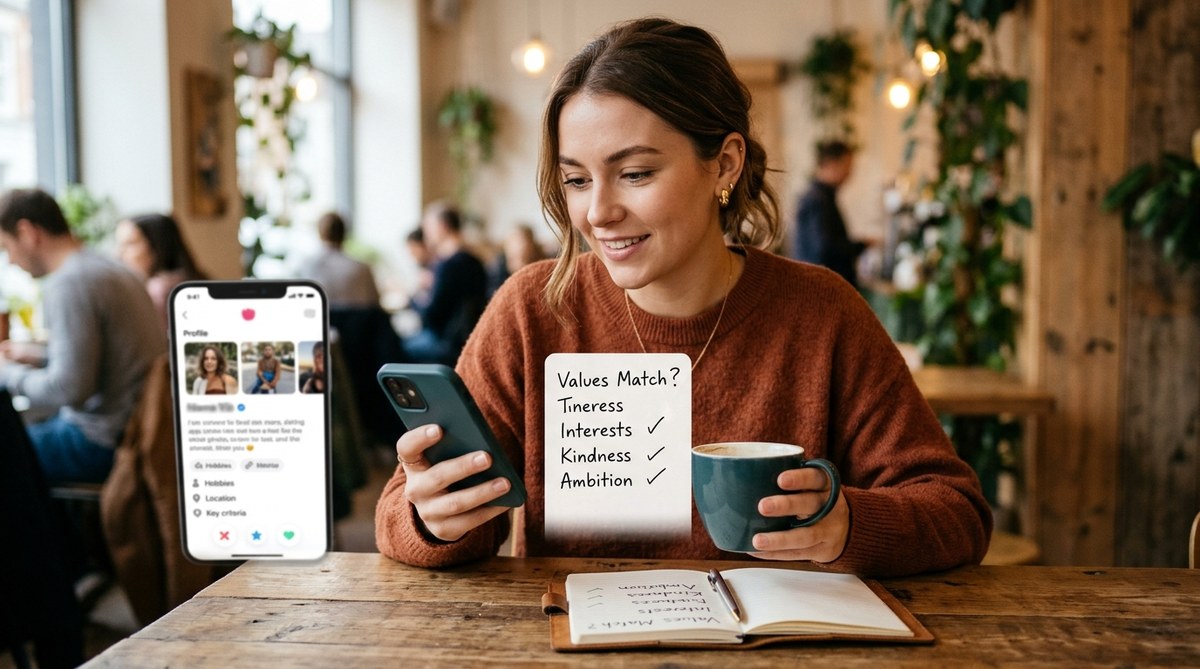
You do not need to overthink this. Use this numbered process every time you open a profile. It takes less than two minutes.
- Scan the photos for lifestyle clues (30 seconds). Count how many photos show everyday life versus curated moments. If the ratio is heavily tilted toward curated, proceed with caution.
- Read the bio for value words (30 seconds). Underline or mentally note any words that point to priorities. If you see three or more value words that align with yours, that is a strong signal.
- Check the prompts for effort and specificity (30 seconds). If the prompts feel like real answers, the person is likely serious about connecting. If they feel like jokes or filler, adjust your expectations.
- Look for consistency (30 seconds). Does the bio match the photos? If someone says they love the outdoors but every photo is indoors, that is a mismatch. Consistency is a marker of honesty.
This process will not guarantee a perfect match, but it will filter out a huge number of people who are not aligned with your values. For more on what to do after you match, see our tips on how to tell if someone’s actually interested or just bored.
Common Mistakes vs. Smart Techniques
Here is a table that clarifies what to avoid and what to practice when you decode a profile.
| Mistake | Why It Fails | Smart Technique | Why It Works |
|---|---|---|---|
| Swiping based on the first photo only | You miss all context and values | Apply the three-photo test | You see patterns in their lifestyle |
| Ignoring the bio entirely | You rely on looks alone | Scan for value words | You find alignment before attraction |
| Treating prompts as filler | You lose the most specific data | Read each prompt for effort | You gauge emotional investment |
| Assuming negativity is honesty | You excuse red flags | Flag defensive language early | You protect your time and energy |
| Matching based on shared hobbies | Hobbies change; values do not | Look for shared values instead | You build a foundation that lasts |
What the Experts Say About Profile Reading
“The most important thing to look for in a dating profile is not what the person says they are looking for. It is what they reveal about themselves without realizing it. A person who writes a thoughtful, specific bio is showing you that they value intention. A person who leaves their bio blank is showing you that they are either not serious or not self-aware. Believe what the profile shows you, not what you hope it means.”
Relationship coach and dating strategist, 2026
This advice cuts to the heart of the matter. People often project their own desires onto a profile. They see a cute photo and fill in the blanks with positive assumptions. But the profile is already telling you the truth. You just have to look.
How to Spot a Profile That Matches Your Values
Values are not the same as interests. You can share a love of hiking with someone who has completely different ideas about family, money, or communication. That is why decoding for values is so important.
Here are the value markers to watch for:
- Family. Mentions of siblings, parents, nieces, or nephews. Phrases like “family is everything” or “Sunday dinners.”
- Growth. References to therapy, books, learning, or self-improvement. Phrases like “always working on myself” or “love a good podcast.”
- Community. Volunteer work, local events, friend groups. Phrases like “my chosen family” or “neighborhood hangouts.”
- Stability. Career mentions, routines, long-term plans. Phrases like “looking for something real” or “building a life.”
When you see these markers, compare them to your own priorities. If a profile has none of these, you are looking at someone who either does not know what they value or does not want to share it. Both are reasons to proceed slowly.
For a complete guide on what to look for before you meet, check out 7 red flags to spot before you even meet your match.
The One Question That Reveals Everything
Before you swipe, ask yourself one question: “If I met this person tomorrow, would I feel like I already know something true about them?” If the answer is yes, the profile has done its job. If the answer is no, the profile is hiding more than it is showing.
This single question cuts through all the noise. It forces you to assess whether the profile gives you a real sense of the person or just a polished surface. Trust that instinct. It is usually right.
Putting It All Together for Better Matches
Decoding a dating app profile is not about being cynical. It is about being intentional. Every swipe is a small investment of your time and emotional energy. When you learn to read profiles for values, effort, and consistency, you stop wasting that energy on people who will never truly fit.
Start using the two-minute system today. Look at the photos for lifestyle clues. Scan the bio for value words. Check the prompts for effort. And before you swipe, ask yourself if you know something real about the person. That is the difference between dating on autopilot and dating with purpose.
If you want to take this skill to the next level, read our guide on how to spot genuine connections in online dating profiles. It will give you even more tools to find the people who are actually ready for what you are looking for.