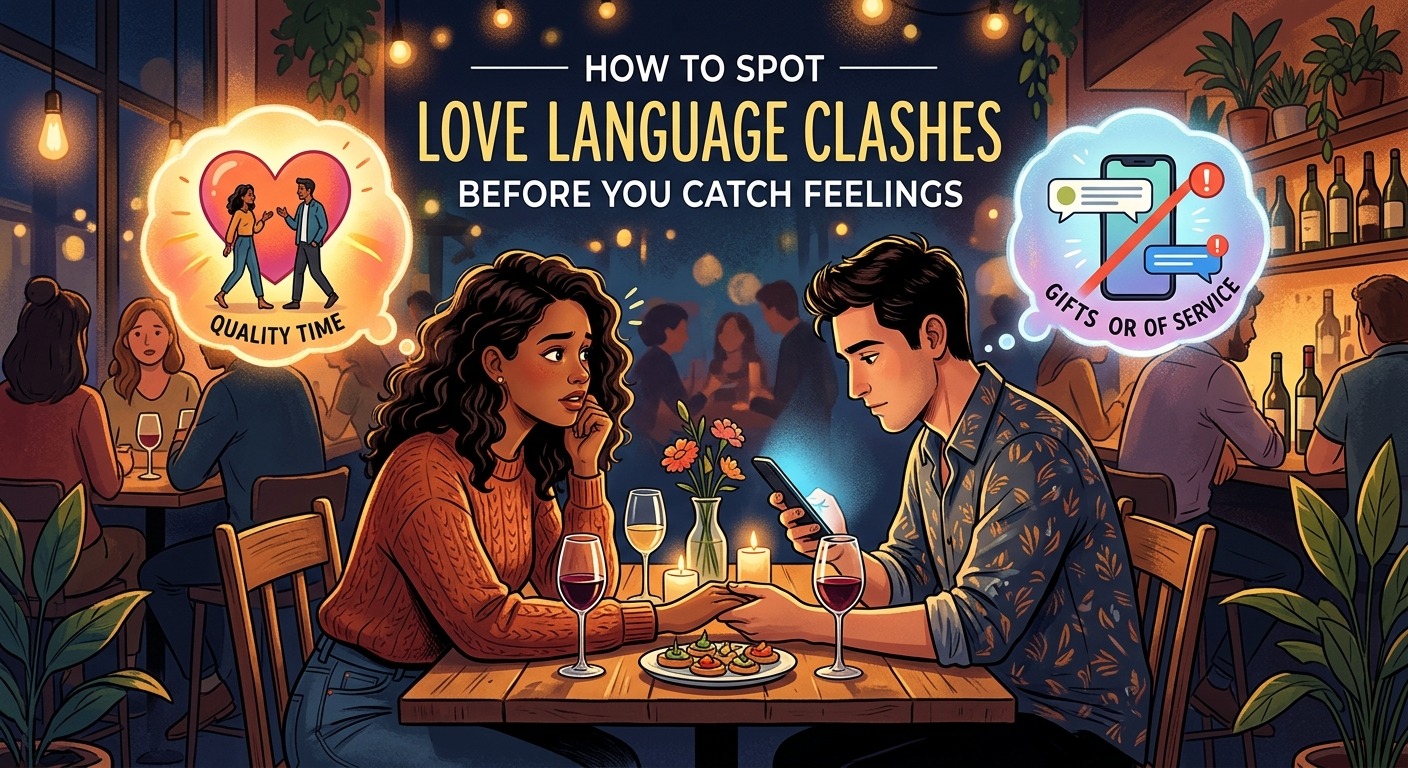
You send a long voice note after your second date, unpacking everything you felt. They reply with “haha yeah fun night.” Not cold. Not disinterested. Just a completely different language. That gap you are already feeling? It has a name.
Reading the Room Early
Love language mismatches happen in almost every new connection, but most people miss them until feelings are already deep. Early dating is packed with subtle signals about how someone gives and receives affection. Learning to read those signals, and understanding your own needs first, can save a lot of confusion. The goal is not to screen a match like a job interview, but to notice what is already there and decide whether it works for you.
The Gap That Shows Up Before You Even Name It
Most people do not walk into a first date thinking about love languages. They are thinking about chemistry, whether the venue was a good choice, and whether they remembered to charge their phone.
But love language dynamics start playing out almost immediately. Before the third date. Before the “what are we” conversation. Before feelings get complicated.
Here is a pattern that plays out constantly. Person A shows interest through words. They text thoughtfully. They give genuine compliments. They check in. Person B shows interest through action. They book the dates, show up on time, handle every logistical detail without being asked. Both are doing their best. But Person A feels ignored because they are not getting meaningful messages back. And Person B feels unappreciated because nobody seems to notice the effort they are putting in.
Neither person is doing anything wrong. They are simply speaking into silence.
What Early Mismatches Actually Look Like in Practice
Love language clashes in early dating are rarely dramatic. They tend to feel like a low-level frustration you cannot quite explain.
You put real thought into a date. You research the restaurant. You remember they mentioned loving live music and find a venue that has both. The date goes well. But they do not seem particularly moved by the effort. They were happy just to spend time with you anywhere. Their love language is quality time, not acts of service. The planning mattered to you, but it did not land for them the same way.
Or maybe you are the one flooding your match with voice notes between dates. Long ones. Thoughtful ones. You are being open, showing that you like them. And they respond with short texts, sometimes hours later. You start reading into it. Are they losing interest? Possibly. But also possibly: they just do not communicate through audio messages. Their version of connection looks completely different to yours.
Physical affection mismatches show up on actual dates too. One person is a natural toucher. A hand on the arm, leaning in close, small contact throughout the evening. The other person is not wired that way. They find that level of physical ease either too full-on or they pull back in a way that reads as cold. Neither reaction is the right one. They are just different.
Why These Gaps Feel Personal Even When They Are Not
The frustrating thing about love language clashes is how quickly the brain turns them into a story about rejection.
They did not respond to my voice note with the same energy. They must not like me as much as I like them.
They did not seem impressed by the date I planned. Maybe I am not enough for them.
In reality, what is often happening is far more neutral. They genuinely do not experience love through the same channel. According to love language theory, most people tend to give affection in the form they most want to receive it. If someone plans every date with care, that is probably how they feel loved too. If someone sends long, meaningful messages, they almost certainly need long messages back. The mismatch is not about how much someone likes you. It is about how they are wired to connect.
Getting Honest with Yourself Before Anything Else
Before trying to decode a match’s love language, you need to be clear on your own. And most people are hazier on this than they think.
You might say “I just want someone who is thoughtful” or “I need to feel like a priority.” Both true. But thoughtfulness and priority look different depending on which love language you lean towards. Does thoughtfulness mean they text first in the morning? Or that they remember something you mentioned weeks ago and bring it up again? Or that they show up with your favourite snack without being asked? Those are three different love languages expressing the same underlying wish.
Taking a love language quiz is a useful starting point here. Not because a quiz gives you all the answers, but because it makes you pause and actually think about which forms of affection have felt most meaningful in your life, and which ones have left you feeling hollow even when someone was clearly trying. That kind of self-awareness matters enormously in early dating, where signals are ambiguous and emotions can run ahead of information.
Once you know your own language, you stop expecting a new match to intuitively figure it out. You start noticing instead whether what they naturally offer lines up with what you actually need. That shift alone cuts a huge amount of early-dating anxiety.
How to Read a Match’s Love Language Without Making It Weird
Watch What They Do Without Thinking About It
You do not need to send someone a personality assessment before agreeing to a second date. Patterns reveal themselves early if you are paying attention.
Here are the signals worth watching across early conversations and the first few dates:
- Words of affirmation: They text with real thought. They tell you specifically what they enjoyed about the date. They give genuine, unprompted compliments rather than generic ones.
- Acts of service: They handle logistics without being asked. They offer to help with something you mentioned in passing. They follow through on small things they said they would do.
- Gift giving: They bring something small to a date, a coffee, something you mentioned enjoying. They notice and remember the details you share.
- Quality time: They are fully present during the date, no phone checking. They make plans promptly rather than vaguely. They want to extend the evening rather than wrap it up early.
- Physical touch: They are naturally comfortable with light physical contact. They lean in when you talk. They greet you warmly and do not pull away from proximity.
None of these signals is definitive on its own. Context matters. First-date nerves exist. But patterns across two or three dates start telling you something real.
Conversation Approaches That Feel Natural
You can also bring love languages into conversation without it feeling like a therapy intake form. Here are ways to raise it gently:
- Ask what made them feel really appreciated by someone they were close to, whether that is a past relationship, a good friendship, or a family member. The answer tells you a lot about what registers emotionally for them.
- Notice how they talk about past connections. Do they mention someone who was “never present” (quality time)? Someone who “never said how they felt” (words of affirmation)? Someone who “never made an effort” (acts of service)? The complaint often names the need.
- Pay attention to what they mention being frustrated by in others, even casually. “I hate when people are flaky” points toward quality time or acts of service. “I need people to just say what they mean” often signals words of affirmation.
- Watch how they treat other people they care about, friends they mention, a sibling, someone close to them. How someone shows love to others is frequently the same way they want to receive it.
- Ask directly but lightly: “How do you tend to show someone you like them?” Most people enjoy answering that. And what they say is genuinely useful, delivered in a completely normal way.
The goal here is not to run a compatibility check or gather data points. It is to have conversations that help you understand who someone actually is. Love language compatibility is one part of that picture, not a tick-box exercise.
When the Clash Is Real vs. When It Is Just Early Caution
Sometimes what feels like a love language mismatch is actually just early-dating guardedness. Someone who seems low on words of affirmation in week one might open up considerably by week four. Some people warm slowly. That is a pace difference, not a language clash.
A real clash looks different. It is when you have been seeing someone for a while and you still consistently feel unseen or unmet, despite both of you genuinely trying. It is when the thing they naturally offer feels misaligned with what you need, and neither of you is going to naturally shift toward the other without real, sustained effort.
A match who communicates entirely through practical action and rarely through words is not broken. They are just potentially incompatible with someone who needs verbal affirmation to feel secure. That is worth knowing before feelings are fully invested, not after.
What Changes When You Know What You Are Looking For
Catching a love language mismatch early does not mean walking away at the first sign of difference. It means you have more information and, as a result, more genuine choice.
Some mismatches are easily bridged. If you know your match’s love language is acts of service and yours is words of affirmation, you can start offering more of what they need and ask them to try offering more of what you need. That kind of conversation is much easier to have before either of you is deep in feelings.
Some mismatches are more structural. Two people whose love languages sit at opposite ends of the spectrum can still care about each other deeply, and still end up exhausted by a connection that never quite hits right. Noticing that gap early, before the investment is too heavy, is not cynical. It is kind to yourself and to them.
The whole point of paying attention in early dating is not to find a perfect match on paper. It is to stop being surprised by things that were always there if you had known what to look for.