You matched with someone great. The banter was solid. You set a time and place. Now the clock is ticking and you are staring at your closet wondering what the next 90 minutes are supposed to look like.
It is normal to feel uncertain about timing. Should you hug or shake hands? How long is too long for dinner? When is the right moment to call it a night? These small decisions can feel huge because you only get one first impression.
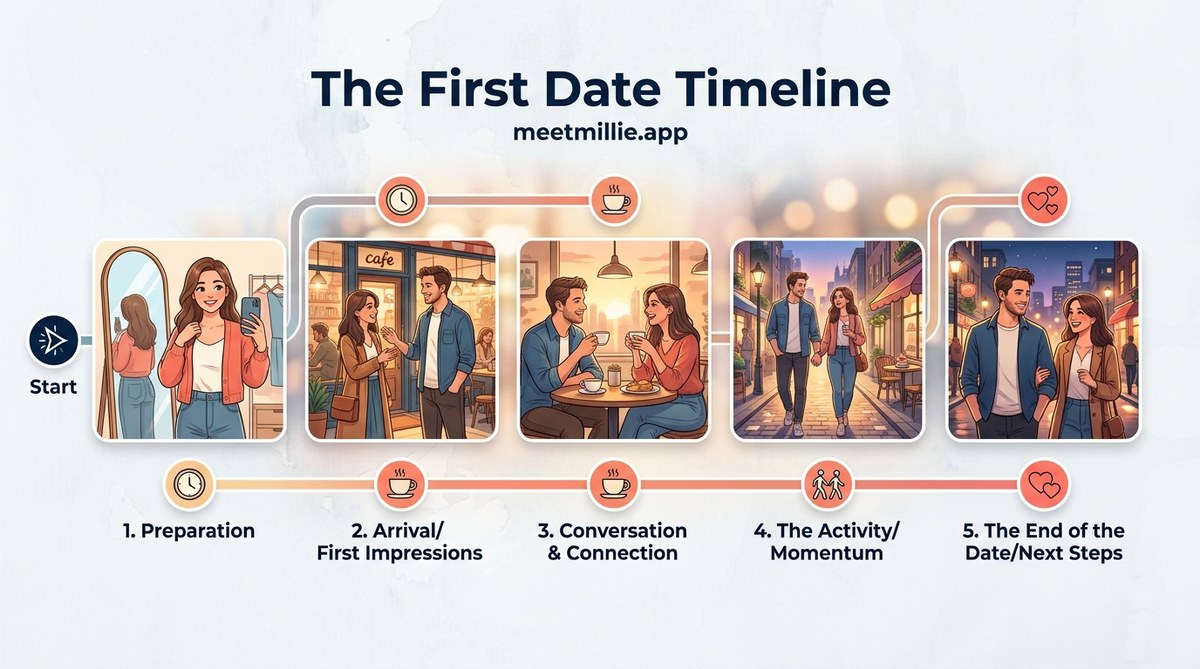
Let us walk through a realistic first date timeline. This is not a rigid script. Think of it as a loose map. It will help you stay present, read the room, and leave feeling good about how things went.
A successful first date is less about perfect timing and more about being adaptable. Aim for 60 to 90 minutes total. Use the first 10 minutes to break the ice, the middle 40 to build a real conversation, and the last 10 to signal the end gracefully. If the energy is high, it is okay to extend. If it feels flat, you have permission to wrap it up early. Trust your gut and prioritize connection over a stopwatch.
The Pre-Date Window: 24 Hours Before You Meet
The timeline does not start when you sit down. It starts the day before.
A quick check-in text the afternoon of the date is a small gesture that builds trust. Something simple works best: “Looking forward to tonight! See you at 7.” This confirms you are both still on the same page and reduces the chance of a no-show.
Plan your outfit and route ahead of time. Choose something that makes you feel confident but comfortable. If you are second-guessing an outfit, swap it now, not 10 minutes before you walk out the door. For help picking the right look, check out our guide on what to wear on a first date.
Give yourself a 10-minute buffer. Arriving a little early lets you settle in, order water, and take a breath. It is much better to be the one waiting calmly than the one rushing in flustered.
The Opening: Minutes 0 to 5
This is the handshake moment. Or the hug moment. Or the awkward wave moment.
Go with a simple, warm greeting. A hug is standard in 2026 for most first dates, but follow their lead. If they offer a handshake, match their energy. The goal here is to break the touch barrier gently without making it weird.
Compliment something specific right away. Not their eyes. That feels rehearsed. Try something like “I love that jacket” or “This place has great energy, good pick.” It shows you are paying attention and sets a positive tone.
Sit across from them, not beside them. Eye contact is easier across a table, and it gives you both personal space. If the table is small, even better. It feels intimate without being invasive.
The Icebreaker Phase: Minutes 5 to 20
The first 15 minutes are the most awkward. Accept that. It is normal.
Start with a low-stakes question. Something tied to their day or the venue works well. “How was the rest of your afternoon?” or “Have you been here before?” These openers are easy to answer and lead naturally into deeper topics.
Avoid interview mode. Do not fire off questions like you are reading a questionnaire. Instead, share something about yourself after they answer. If they mention they love hiking, say “I got into trail running last summer. What is your favorite local spot?” This turns a question into a conversation.
If you hit a silence, do not panic. Take a sip of your drink. Look around the room. Then say something like “I always get nervous before these things, but you are easy to talk to.” Vulnerability is attractive. It also gives them permission to admit they feel the same way.
If you need more help keeping the chat flowing, read our list of 7 conversation starters that actually work on a first date.
The Connection Zone: Minutes 20 to 50
This is where the date finds its rhythm. You have moved past small talk. Now you are learning who they really are.
Ask questions that reveal values, not just facts. Instead of “What do you do for work?” try “What part of your job makes you feel the most alive?” Instead of “Do you have siblings?” try “What was dinner like growing up in your house?” These questions invite stories. Stories build connection.
Listen more than you talk. A good rule of thumb is to aim for a 50/50 split. If you notice you have been talking for two minutes straight, pause and ask them a question. People remember how you made them feel, not the clever things you said.
Use their name a couple of times during this phase. It is a simple psychological trick that builds rapport. Do not overdo it. Just once or twice naturally.
Watch for signs they are engaged. Are they leaning in? Making eye contact? Laughing at your stupid jokes? Those are green lights. If they are checking their phone or looking around the room, the energy is off.
The Pivot: Minutes 50 to 60
Around the one-hour mark, check in with yourself. How do you feel? More importantly, how do they seem?
If the conversation is flowing and neither of you has glanced at a clock, you can let the date extend naturally. Order another drink. Suggest splitting a dessert. This signals that you are enjoying their company.
If there is a lull or you feel a little tired, it is okay to start winding down. You do not need to stay for two hours just because you feel obligated. A great 60-minute date is better than a mediocre 90-minute one.
Here is a simple table to help you decide:
| How You Feel | How They Seem | What To Do |
|---|---|---|
| Engaged and curious | Engaged and laughing | Extend. Suggest a walk or a second drink. |
| Neutral | Neutral | Finish your current round and wrap up naturally. |
| Disconnected | Disinterested | End the date politely. No need to drag it out. |
| Great chemistry | Shy but warm | Ask a playful question to draw them out. |
The Graceful Exit: Minutes 60 to 75
This is the most important part of the timeline. Do not let the date fizzle out into an awkward silence.
Signal the end with a clear, warm statement. Something like “I have had a really nice time tonight, but I should probably head out soon.” This gives them a moment to react. If they say “Same here, let me walk you out,” you are in sync. If they say “Oh, already? Stay for one more,” you can decide if you want to.
Pay the bill smoothly. If you offered to pay, handle it without fanfare. If they offer to split, accept gracefully. For more nuance on this moment, read our guide on should you split the bill on a first date.
The goodbye sets the tone for what comes next. A hug is standard. A handshake is fine if that is their energy. If you want to kiss them, read the room. Are they lingering? Making eye contact? Leaning in? That is your green light. If you are unsure, it is better to wait. You can read more about how to read the moment for a first date kiss.
End with a specific compliment. “I really enjoyed talking with you tonight” is fine. “I loved hearing about your trip to Japan, that was fascinating” is better. It shows you were listening.
The Post-Date Window: The Next 24 Hours
The date is over, but the timeline is not done yet.
Send a text within a few hours or the next morning. It does not need to be long. “Got home safe. Thanks for a great evening. Let’s do it again soon” is perfect. It shows interest without desperation.
If you are not feeling it, a polite message is still kind. “Thanks for a nice night. I don’t think we are a romantic match, but I wish you the best.” It is honest and respectful. Ghosting is never the move.
If you are unsure how you feel, give it 24 hours. Sometimes a good date does not hit you until the next day. Sit with the feeling before you decide.
For a deeper look at the post-date communication, check out our guide on the post-first-date text.
Common Timeline Mistakes to Avoid
Even with a good plan, things can go sideways. Here are the most common timing errors people make:
- Staying too long out of politeness. If you know by minute 30 that there is no spark, you do not need to stay for another hour. It is kinder to end the date early than to fake enthusiasm.
- Rushing through the first 10 minutes. Some people try to get all the big questions out right away. Slow down. Let the conversation breathe.
- Checking your phone. Even a quick glance can make the other person feel unimportant. Keep your phone in your pocket or bag.
- Drinking too much too fast. Nerves are real. But a second drink before the first one is finished can blur your judgment. Pace yourself.
- Overthinking the goodbye. Do not plan a speech. A simple “I had a great time” followed by a hug is all you need.
“The best first dates feel like a conversation with an old friend you just met. If you focus on being curious rather than impressive, the timeline takes care of itself.” – Millie, dating coach and founder of Meet Millie
Putting the Timeline Into Practice
You do not need to memorize every minute. The first date timeline is a framework, not a prison.
Arrive calm. Start warm. Build slowly. Exit clearly. Follow up kindly.
That is the whole formula.
If you want to prepare even more, review our first date checklist before you head out the door. It covers everything from breath mints to backup conversation topics.
Your Next Move
You now have a clear picture of how a first date should flow. The only thing left is to book the date.
Trust yourself. You are more capable than you think. The right person will not care if you fumble a word or pause for a second too long. They will care that you showed up, that you listened, and that you were real.
Go enjoy that coffee. Or that drink. Or that walk in the park. You have got this.