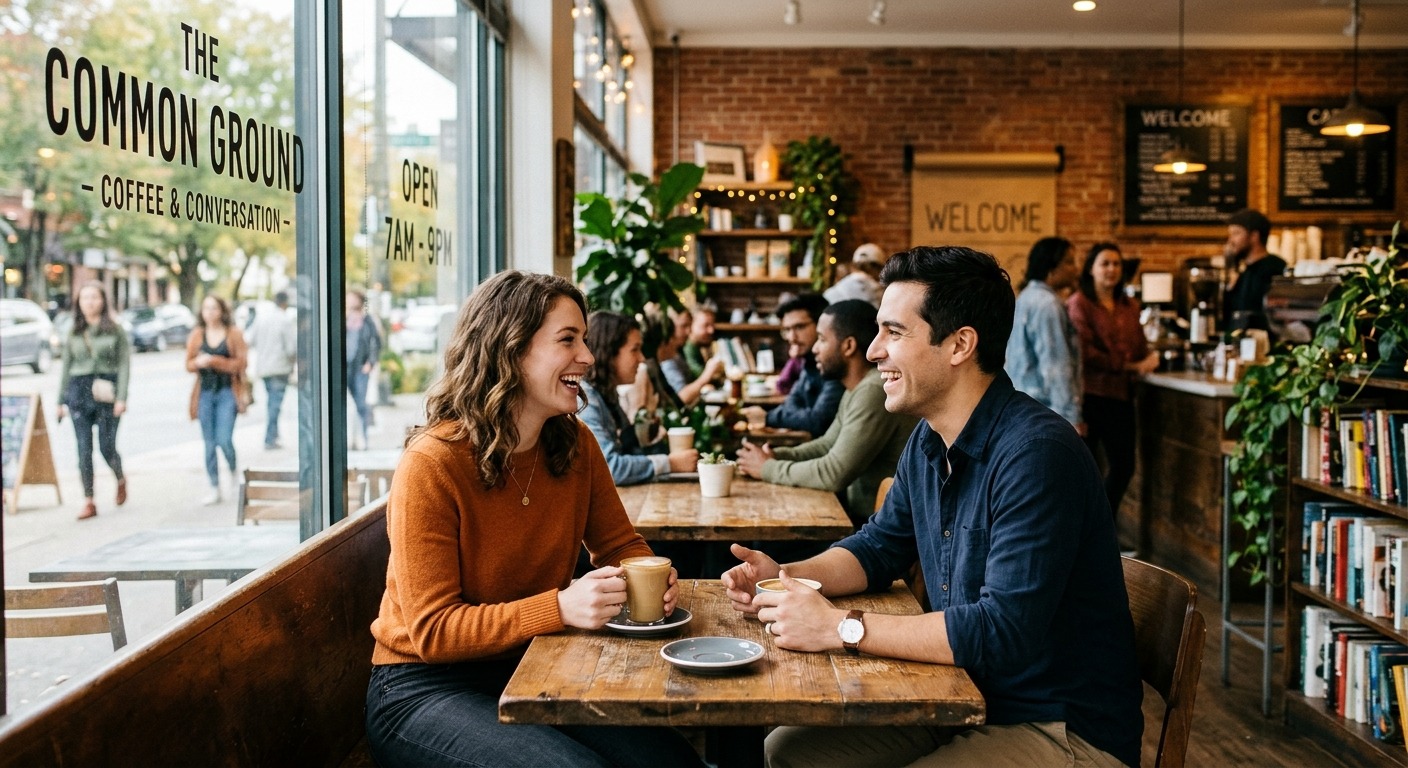
Your match suggests a bar across town. The photos look lovely, but the last train leaves early, you cannot tell whether there is indoor seating, and you already feel uneasy about getting home. You do not have to agree just because someone picked a place. A good first-date venue should leave you free to enjoy the conversation, manage your own travel, and head out whenever you choose.
Your Comfort Comes First: Choose somewhere public, staffed, and easy to reach. Check the journey home before agreeing, and look for an atmosphere where you can hear each other without feeling exposed or isolated. Keep the first meeting manageable, with a clear starting point and an easy exit. If a venue does not work for you, suggest a specific alternative. You do not need a dramatic reason to prefer somewhere else.
Start With a Public Place Where You Can Settle In
For an initial meeting with someone from a dating app, choose a venue where other people and staff will be around. A café, casual restaurant, or busy gallery café can give you space to talk while keeping the meeting in a shared setting.
Public does not automatically mean comfortable. A huge park may have quiet stretches. A station entrance might be crowded but unpleasant for waiting. Think about the exact meeting point and what it will feel like at the time you plan to arrive.
A useful starting question is: could I arrive alone, wait comfortably, and leave independently? If the answer depends on your date collecting you, finding you somewhere secluded, or taking you to a second address, adjust the plan.
Check These Details Before You Agree
- Staff presence: Choose somewhere with staff working throughout your planned visit.
- A precise meeting point: Agree to meet inside the venue or at its main entrance.
- Opening hours: Confirm that you will have enough time before closing.
- Seating: Check whether you need a reservation or whether getting a seat is uncertain.
- Access: Look into steps, accessible bathrooms, seating needs, or anything else that affects your comfort.
- An independent exit: Make sure you can leave without relying on your date for a ride.
You can keep the first meeting short without making it feel clinical. “Shall we grab coffee at three? I have about an hour” sets a clear expectation. If you both want more time, you can decide that after meeting.
Plan the Journey Home Before Picking the Venue
A place can look ideal until you check the return trip. Two buses and a long walk might feel manageable on a map, then feel very different after dark or in heavy rain. Consider the full journey, including the distance between the venue and your stop.
Check return services for the actual day of your date. Weekend schedules may differ from weekday ones. Leave enough time to reach your transport without rushing, and have a backup you could realistically afford.
If you plan to book a taxi or ride through an app, identify somewhere nearby where you would feel comfortable waiting. If you drive, think about the walk back to your car and whether the parking area will still be open.
Meeting at the venue gives you control over your arrival and departure. You can appreciate an offer of a ride and still decline it: “Thanks, I’ll make my own way there. See you inside.” You do not need to share your home address to arrange a first meeting.
A fair location does not always sit exactly halfway between two homes. One person might have a direct train while the other faces several connections. Compare the effort involved, then choose somewhere workable for both of you.
Choose an Atmosphere That Makes Conversation Easier
The venue should support the kind of date you want. If you hope to chat, a loud bar may leave you leaning close before you feel ready. A very formal restaurant can create pressure around price, dress, and how long you are expected to stay.
Look for a middle ground: enough activity that you are not alone, enough space to feel comfortable, and a noise level that lets you speak normally. Venue photos and recent reviews may offer clues, though they cannot tell you exactly how a particular visit will feel.
Budget belongs in this conversation too. Agreeing on coffee or a casual meal can remove uncertainty. Nobody should have to stretch their finances to seem interested.
How Common First-Date Venues Compare
| Venue | What Can Work | What to Check |
|---|---|---|
| Staffed café | A simple plan with a flexible length | Seating, closing time, and peak-hour noise |
| Casual restaurant | A shared meal with time to talk | Prices, reservations, and dietary options |
| Gallery with a café | Conversation prompts and somewhere to sit afterward | Tickets, café hours, and access needs |
| Busy neighborhood bar | An informal evening meeting | Music volume, seating, and appealing alcohol-free drinks |
Use Local Information as One Planning Detail
If you are meeting in an unfamiliar area, checking crime by postcode can be an optional planning step. You might use it alongside checking the route from the station, the venue’s opening hours, and where you could wait for transport.
Local statistics cannot guarantee personal safety. They describe recorded incidents across an area and a period of time. They cannot predict how your date will behave or tell you exactly what a particular street will feel like when you arrive.
A lower figure is no reason to ignore discomfort. A higher figure does not tell you everything about a neighborhood or the people who live there. Keep the information in proportion, and avoid treating a postcode as a verdict on a person.
If the area still feels unfamiliar, choosing a venue you already know is a reasonable option. You do not need to research every possible location before deciding that your usual café would help you relax.
Suggest Another Location With a Clear Alternative
Changing the venue can feel awkward when you like someone and want the conversation to stay easy. A useful approach is to show interest, state your preference, and offer a concrete alternative. Keep it brief. There is no need to build a case for your own comfort.
If their suggestion is too far away, try: “I’d like to meet. That area is tricky for my journey home. Would the café near Central Station work at six?”
If they suggest meeting at home, you could say: “I prefer somewhere public for a first meeting. How about coffee at Riverside Café on Saturday?”
If the venue feels too expensive or formal, try: “I’d be more comfortable keeping our first date casual. Fancy coffee instead?”
You can also change a plan you already accepted. “I checked my return journey, and that location won’t work for me. Could we meet near the station instead?” gives enough context without turning the message into an apology.
Pay Attention to How They Handle Your Preference
Your match may have a different suggestion or a practical constraint of their own. That can be a normal conversation. Look for whether you can both discuss it respectfully and reach an arrangement that works.
Repeated pressure is different from a scheduling problem. If they mock your preference, demand your address, or insist that you owe them trust, you can decline the meeting. You do not have to keep negotiating until they accept your boundary.
A simple closing message is enough: “That plan doesn’t work for me, and I’m going to leave it here.”
Give Yourself a Simple Plan for the Day
Preparation should help you feel freer during the date. Once the venue is agreed, sort out a few basics, then let yourself look forward to meeting someone new.
- Confirm the details: Check the venue name, address, time, and reservation if needed.
- Tell someone you trust: Share where you are going, who you are meeting, and your expected return time.
- Charge your phone: Bring a power bank if you are likely to need one.
- Keep travel money available: Have a way to pay for your own journey home.
- Choose your own pace: Order what you want and decide whether you want alcohol.
- Keep your belongings nearby: Make leaving straightforward.
- Have an exit sentence ready: “I’m heading home now. Take care” is a complete statement.
If you arrive and the venue is closed, deserted, or very different from what you expected, pause before agreeing to a replacement. You can suggest another nearby public venue or reschedule. A last-minute change does not commit you to going somewhere private.
If you feel uncomfortable during the date, you can leave without waiting for the conversation to reach a natural ending. If you need help arranging your departure, approach venue staff or contact someone you trust. Courtesy does not require staying.
Pick a Place That Lets You Be Present
The right first-date spot does not have to be impressive. It needs to work for your budget, your journey, your access needs, and your comfort. Familiar surroundings and a manageable plan can leave more room for the part you actually care about: finding out whether you enjoy each other’s company.
Before you confirm, check that you can get there, talk comfortably, and leave on your own terms. Then send the message, choose something you feel good wearing, and let the date be a conversation. You are allowed to be interested in someone and thoughtful about your own needs at the same time.